

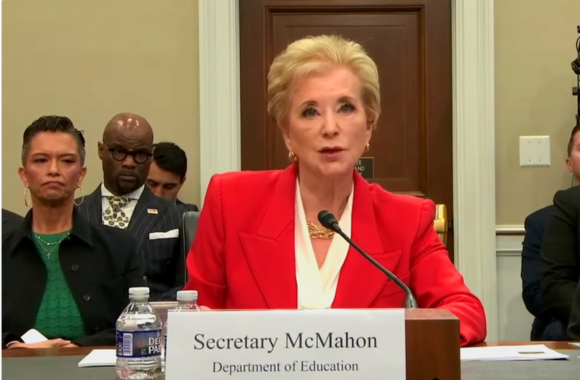
Education Department Agrees To End Race-Based Eligibility For McNair Program
The Education Department has quietly agreed to rewrite eligibility rules that treated race as a disqualifier for a federal graduate-prep scholarship, resolving a lawsuit that challenged the policy. This move affects a long-running program aimed at helping college students prepare for doctoral studies and changes the ground rules for who can apply. The decision signals a shift in how federal student support programs may treat race-conscious criteria going forward.
What Changed
According to the settlement, the agency will remove exclusionary, race-based eligibility language and replace it with neutral criteria that focus on academic preparation and need. “That means the McNair Post-Baccalaureate Achievement Program–a federal program distributing roughly $60 million annually to help students pursue graduate education–will no longer discriminate based on…
The rewrite does not eliminate the program; instead it retools who can benefit and how participants are selected, keeping the goal of boosting graduate school entry while aligning rules with constitutional limits.
Why This Matters
The McNair Program has been a major federal effort to diversify doctoral pipelines and to give low-income and first-generation students a leg up into graduate study. Changing the eligibility criteria could broaden access for some applicants while excluding race as a deciding factor, which will alter outreach and recruitment strategies at colleges. The practical result will be a reshuffling of how institutions identify eligible students and document qualification under the new standards.
For students, the immediate effect is uncertainty mixed with opportunity: those previously excluded solely because of race may now be able to apply, while those who relied on race-conscious pathways might see a different competitive field. Colleges that host McNair programs will need to revise their application materials, advising scripts, and selection rubrics to reflect the neutral criteria. That process could be fast for some campuses and slow for others, depending on administrative bandwidth and legal counsel.
Legally, this settlement is notable because it resolves a challenge without a Supreme Court ruling but still signals the Department’s willingness to adjust federal program rules to avoid constitutional conflict. Advocates on both sides will parse the language closely, since the exact neutral criteria and how they are implemented will determine whether the program remains effective at supporting underrepresented scholars. The outcome may influence how other federal education initiatives write eligibility clauses going forward.
Colleges should prepare by auditing their McNair recruitment and selection processes now, documenting outreach, and ensuring that alternative markers of disadvantage and academic potential are clear and legally defensible. Institutions that want to preserve diverse candidate pools can lean into race-neutral measures that correlate with underrepresentation, such as first-generation status, income indicators, school context, and research potential. Clear, transparent rubrics will help defend selections if legal questions arise later.
The stakeholders most affected—students, faculty mentors, and program directors—will watch the Department’s rewritten guidance for details on timelines, permissible outreach, and allowable priority groups. Meanwhile, students interested in graduate study should contact campus McNair offices to learn how the changes affect current and future cohorts. The program’s mission to prepare promising scholars for doctoral study can continue, but it will do so under new rules that emphasize neutral eligibility over race-based gates.
This is more than an administrative tweak; it is a moment that will reshape how federal graduate-preparation support is offered and who gets to claim that support. Expect litigation, policy memos, and campus-level strategic shifts as everyone adjusts to the rewrite and tests its practical effects on access to graduate education.