

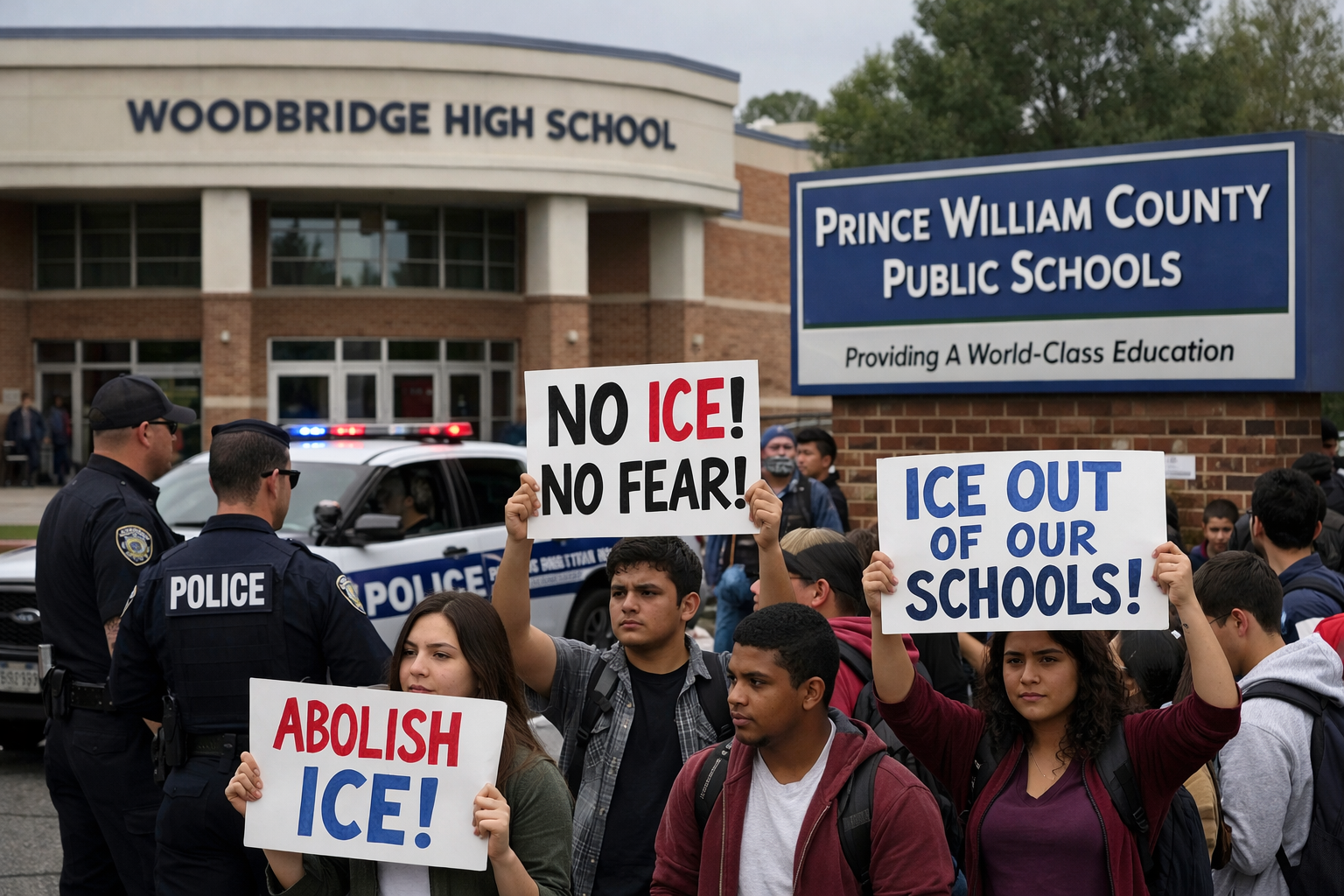
📣 Virginia Suspends Students After Walkout; Organizers Push Larger Protest
WOODBRIDGE, Va. — Prince William County Public Schools confirmed that 303 students at Woodbridge High School were suspended after a student-led walkout on Feb. 13 that spilled off campus and prompted a police response. The suspensions stemmed from students leaving school grounds during the instructional day to protest U.S. Immigration and Customs Enforcement (ICE), highlighting an escalating conflict between student activism and school safety protocols.
School officials made clear the disciplinary action was tied to code-of-conduct violations, not the political substance of the protest. “Students did not remain on school grounds and instead left campus,” Principal Heather Abney wrote in a letter to parents, emphasizing that leaving the campus without permission posed safety concerns and violated district policy.
View this post on Instagram
The incident at Woodbridge occurred as broader student protests against ICE have appeared in multiple Virginia school districts this month, including walkouts at Albemarle County and Alexandria City schools. While those earlier events mostly stayed on campus, administrators at Woodbridge said the Feb. 13 demonstration crossed established boundaries.
Podcast: Joni Eareckson Tada — Finding Purpose in Paralysis
Safety and Discipline Focused, Not Political Suppression
District leaders and law enforcement officials involved in managing the walkout maintained that safety obligations, not viewpoint discrimination, drove the suspensions.
Prince William County Police were deployed to manage traffic and ensure student safety when demonstrators occupied nearby streets during school hours. Administrators insisted the commuter traffic and public roadways posed risks for minors without oversight.
School board representatives echoed this position, noting that officials respect constitutional rights but must enforce rules guaranteeing student supervision and order. Because students walked off campus and congregated at off-site locations, administrators classified the absence as a violation of school procedures.
Organizers Plan Larger, Countywide Protest
In response to the suspensions, an Instagram account identified as @pwcs_iceout — standing for Prince William County Schools ICE OUT — announced plans for a countywide walkout scheduled for Friday, Feb. 20. Organizers urged students to bring posters, flags, and speakers, and to meet at specified locations on their individual campuses.
The posts stressed that the walkout would be peaceful and not endorsed by school administrators. They also asserted that “all school administrations have been informed of our plans, so participating will not get you in trouble,” though district leadership has not publicly backed that claim.
Organizers urged participants to avoid conflict, stating that a calm demonstration would better convey their message than confrontational tactics.
Discipline Action Highlights Broader Tension Over Political Expression
Commentators on this and related student protests have pointed out a growing trend of demonstrations during school hours, with varying degrees of administrative response. Some argue that student activism is a form of civic engagement; others contend that unsupervised walkouts disrupt education, encourage truancy, and sidestep institutional responsibilities.
A conservative education watchdog described the disciplinary response as “a necessary display of institutional backbone,” arguing that enforcing conduct rules deters future disruptions and preserves school time for learning.
Critics of lax school discipline have observed that marking protests as mere unexcused absences often carries minimal consequences, which can incentivize repeated walkouts. In contrast, decisive enforcement — such as the three-day suspensions at Woodbridge — sends a clearer message about expectations and accountability.
Historical Legal Context: Student Speech Rights Vs. Conduct Rules
Legal precedents dating back to Tinker v. Des Moines affirm that students do not shed constitutional rights at school so long as their actions do not materially disrupt educational activities. However, courts have also upheld administrators’ authority to regulate conduct that significantly interferes with school operations and safety.
This legal backdrop underscores why school officials differentiate between peaceful on-campus expression and unauthorized departure from campus during class hours.
Community Reaction and Long-Term Implications
Parents and community members have voiced a range of reactions. Some expressed concern that punishments are too harsh or could chill free speech. Others praised the district for prioritizing safety and teaching students the consequences of breaking rules. On social media, posts and videos about the Woodbridge action continue to circulate.
📱 X Post:
“Woodbridge administration enforces code of conduct — 303 students suspended. Safety and order matter.” — @VAParents2026
📱 X Post:
“Students organize larger walkout Friday. Will schools uphold discipline or capitulate?” — @EduPolicyWatch
🧠 Final Analysis
Parents, educators, and policymakers are closely watching this case. The tensions between free expression and institutional order are not new, but the scale of the Woodbridge suspensions reflects heightened sensitivities around school governance and political activism during class hours. Whatever one’s views of ICE or immigration policy, this episode raises pressing questions about how far student advocacy can go before infringing on schooling obligations and safety protocols.