

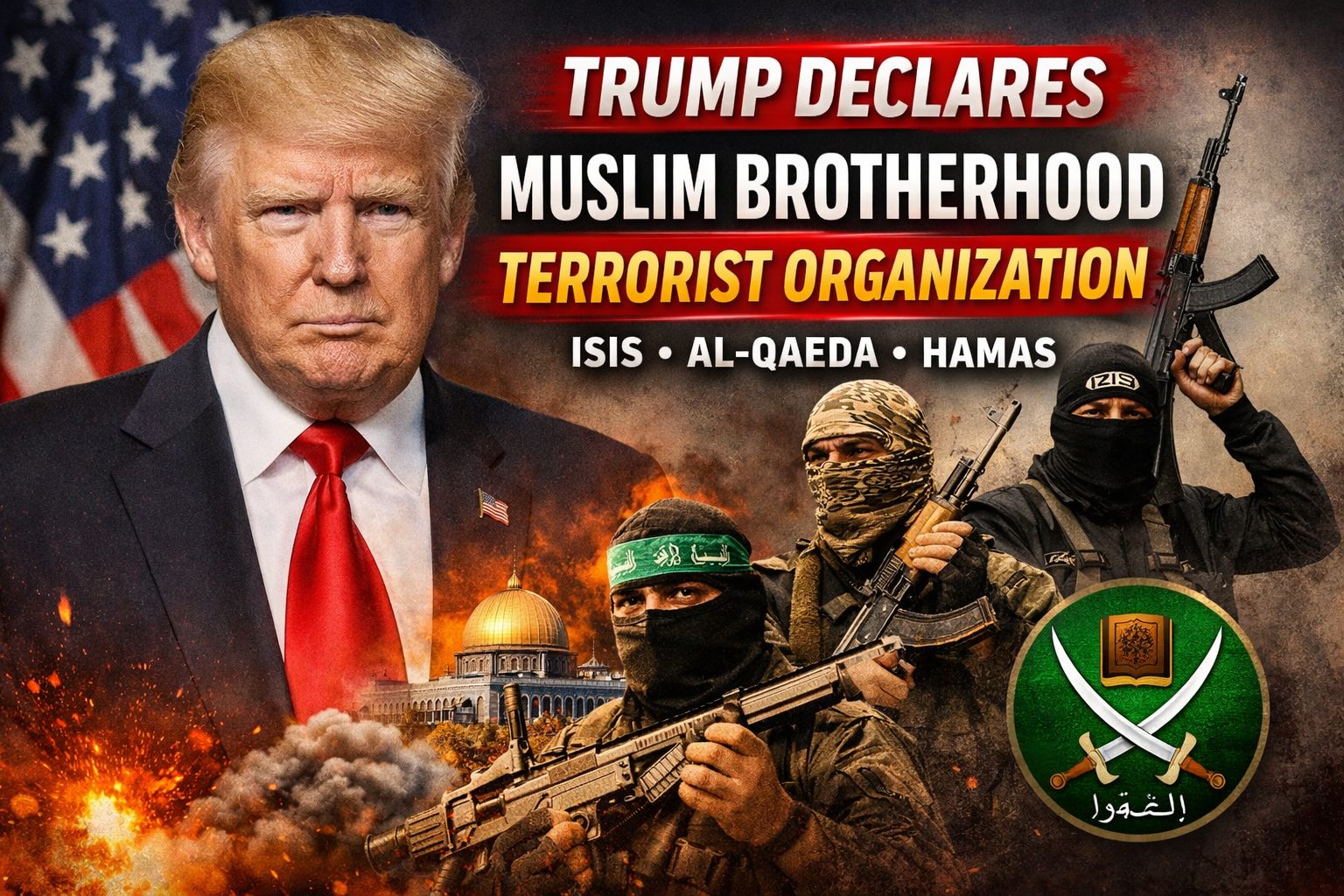
Trump Labels Muslim Brotherhood Branches as Terrorist Organizations—Root of Modern Jihadism Targeted
On January 13, 2026, the United States government took decisive action by designating key regional branches of the Muslim Brotherhood as terrorist organizations and specially designated global terrorists under U.S. counterterrorism law.
The move, coordinated by the Department of the Treasury’s Office of Foreign Assets Control (OFAC) alongside the State Department, reflects a long-promised effort by the Trump administration to address the roots of Islamist militancy.
Treasury Secretary Scott Bessent stated that the Egyptian and Jordanian Muslim Brotherhood branches were being listed under Executive Order 13224, as amended, due to their material support to aggressive militant groups such as Hamas, which Washington and its allies have long labeled terrorist entities. This action, administration officials argue, deploys the full scope of U.S. counterterrorism authorities to disrupt networks that enable, finance, and perpetuate violence against American interests and allied nations.
In a parallel designation, the State Department labeled the Lebanese Muslim Brotherhood—also known as al-Jamaa al-Islamiyah—both a Foreign Terrorist Organization (FTO) and a Specially Designated Global Terrorist entity. The secretary-general of that organization, Muhammad Fawzi Taqqosh, was individually added to the sanctions list.
These designations place sanctions on financial assets, prohibit material support and transactions with the named groups, and empower U.S. enforcement agencies to pursue legal action against individuals and entities tangentially connected to the networks. While the Brotherhood claims to be a political and social movement, federal officials have concluded that certain chapters have concealed support for violent actors under a veneer of civic legitimacy.
For decades, the Muslim Brotherhood has been a controversial organization in Middle Eastern geopolitics and Western security discourse. Founded in Egypt in 1928, its ideological reach and organizational influence grew across the region, eventually spawning offshoots such as Hamas. Critics have long maintained that its doctrines laid the intellectual groundwork for Salafi-jihadist movements later embodied by al-Qaeda and ISIS.
A growing body of open-source research shows that prominent militants, including Osama bin Laden and Ayman al-Zawahiri, were once aligned with Brotherhood-linked circles prior to founding or leading more violent networks. Those ideological pedigrees continue to inform extremist strategies that spurn pluralistic politics in favor of armed confrontation.
The U.S. government’s formal action follows an executive order signed by President Trump in late 2025, which directed senior national security officials to review Muslim Brotherhood chapters for foreign terrorist designation under U.S. law. That order recognized the transnational nature of the Brotherhood and its capacity to enable threats to U.S. citizens, partners, and interests abroad.
In his remarks at the January 13 designation announcement, Secretary Bessent emphasized that the Brotherhood’s public façade of peaceful civic engagement belies documented contributions to destabilization and support for Hamas operations. By severing these chapters from the global financial system and restricting their access to resources, the administration intends to undercut sources of violence and enhance regional stability.
Critics of the designation have raised concerns about its potential impact on political freedoms in the Middle East, arguing that broad terror labels can be exploited by authoritarian regimes to suppress dissent. However, backers within the U.S. national security community argue that measured sanctions against violent supporters are necessary to thwart long-term threats. U.S. policymakers point to historical ties between Brotherhood affiliates and violent campaigns in Gaza and elsewhere as justification for the action.
The designations have also garnered attention on social media platforms. On X, conservative commentators highlighted the ideological lineage of Islamist terrorism, emphasizing the Brotherhood’s role as what they call “the progenitor of ISIS, al-Qaeda, and Hamas.” One widely shared post stated:
“This is more than bureaucracy. This is a strategic counterstrike against the roots of global jihadism.” — X user @NatSecurityNow
On video platforms, analysts noted that the designations could reshape Middle Eastern political landscapes and offer fresh leverage against militant sponsorship networks. A recent short video overview explained this designation as a watershed moment in U.S. counterterrorism policy, underscoring connections between Brotherhood ideology and subsequent jihadist violence.
Foreign governments have reacted with mixed messages. Several Middle Eastern states, including Egypt, have maintained longstanding hostility toward the Brotherhood, even outlawing the group domestically. Other regional governments are carefully watching the implications of Washington’s sovereign decision, mindful of its effect on diplomatic relations and internal security dynamics.
Within the United States, conservative policymakers and national security experts have broadly supported the Trump administration’s action. They view it as a long-overdue acknowledgment of the ideological and operational links between Islamist networks and violent jihadist groups that have repeatedly targeted American interests abroad. Moreover, they argue that this designation represents a stronger posture in the ongoing global struggle against violent extremism.
While some advocacy groups have condemned the designation, saying it could chill legitimate political or civil society activities among Muslim communities, federal counterterrorism officials emphasize that U.S. law targets material support for terror, not lawful religious practice.
As enforcement unfolds, U.S. Treasury and State Department officials say they will continue to monitor emerging threats and, where necessary, pursue further designations to protect national security.
🔑 High-Value Keywords (10)
-
Muslim Brotherhood
-
Terrorist designation
-
Executive Order
-
U.S. national security
-
Hamas connections
-
Specially Designated Global Terrorists
-
Salafi jihadism
-
Treasury sanctions
-
Islamist ideology
-
Counterterrorism policy