

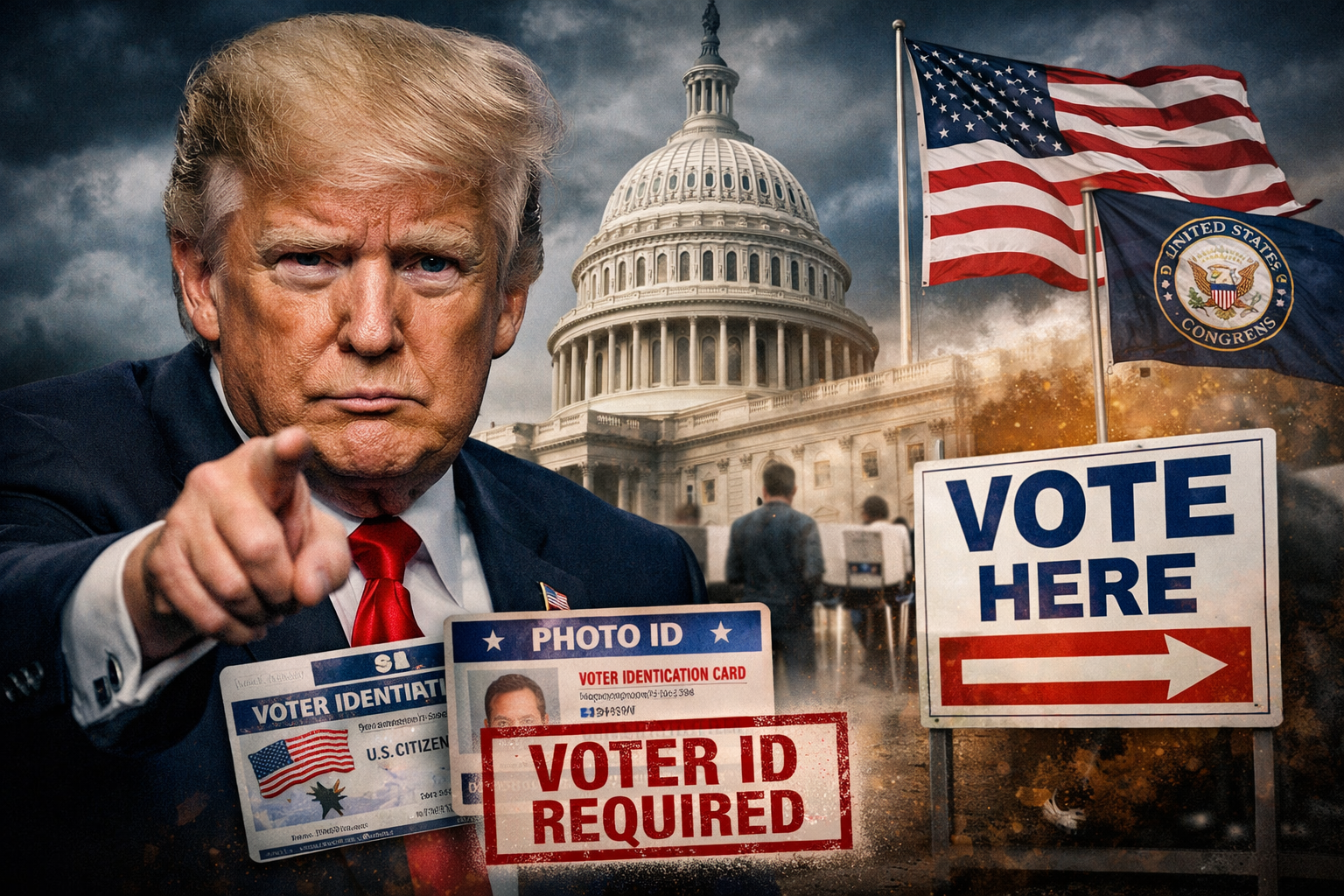
Trump Guarantees Voter ID for Midterms — Congress or Not
President Donald J. Trump has declared that a nationwide voter identification requirement will be in effect for the 2026 midterm elections, asserting federal action even if Congress fails to act on election reforms. His comments, delivered on social platform Truth Social, have ignited a debate over presidential authority and the future of election integrity in the United States.
In a blunt post on his Truth Social account, Trump wrote, “There will be Voter I.D. for the Midterm Elections, whether approved by Congress or not!” and warned that Democrats are resisting the measure for political advantage. The president signaled he is ready to utilize alternative legal avenues — including an executive order — to implement the requirement if legislative action stalls.
🧠 Trump’s Rationale and Political Framing
Trump’s announcement comes as the Republican-backed Safeguard American Voter Eligibility (SAVE) Act — a House-passed proposal that would mandate proof of citizenship and a photo ID to vote — faces an uphill battle in the Senate. The SAVE Act’s narrow passage in the House has drawn both support from election security advocates and criticism from opponents who argue it oversteps federal authority and could complicate state-run election systems.
In his Truth Social posts, Trump accused Democratic leaders of opposing voter ID requirements because they allegedly want to exploit weak election rules. He wrote that he has investigated “legal Arguments not yet articulated or vetted on this subject” and plans to present them in a forthcoming executive order.
⚖️ Constitutional Authority and Legal Questions
Constitutional scholars and election law experts traditionally agree that the U.S. Constitution grants primary election oversight to states, with Congress holding limited authority to regulate federal election timing and procedure but not to nationalize all election rules. Trump’s intention to issue an executive order to impose nationwide ID rules raises questions about separation of powers and legal feasibility.
Under current law, states retain significant autonomy over how they conduct elections, including whether to require voter ID at polling places. Many states already maintain some form of identification requirement; however, a federal mandate affecting all states would represent a significant shift in the electoral landscape.
🇺🇸 House GOP Push and Legislative Standoff
The House of Representatives recently advanced the SAVE America Act, a bill Republicans support as a mechanism to enforce stricter voter ID and citizenship documentation requirements. While the House passed the legislation, its prospects in the Senate are uncertain due to the chamber’s rules and the need for a 60-vote threshold to overcome a filibuster.
Proponents argue that uniform ID standards bolster public confidence in election outcomes by ensuring that only eligible citizens cast ballots. Critics counter that conservative messaging on voter fraud has outpaced evidence of widespread issues, and that aggressive federal mandates may disrupt well-established state election processes.
📱 Trump’s Truth Social Messaging
Trump’s Truth Social posts have served as the primary vehicle for his announcement, allowing him to bypass traditional media filters and communicate directly with supporters. In his messaging, he directly blamed Democrats for resisting voter ID reforms, characterizing opponents as prioritizing political gain over election security.
These posts have also amplified complaints about mail-in ballots and election procedures in general, themes Trump has emphasized since his 2020 campaign. While his rhetoric frames voter ID as common-sense policy, many legal observers remain skeptical of unilateral action without clear statutory backing from Congress.
📺 Relevant Social Media Content
X (former Twitter)
📌 Trump reaffirming his plan to require voter ID in midterms regardless of congressional approval:
“There will be Voter I.D. for the Midterm Elections, whether approved by Congress or not!” — @realDonaldTrump
Source: Truth Social quotes shared on X via Reuters reporting.
Broader Implications for the Midterms
Trump’s vow to impose voter ID requirements underscores the heightened political stakes of the 2026 midterm elections. Republicans see election security reforms as essential to restoring voter confidence and ensuring the integrity of results, particularly after concerns raised by Trump and GOP allies about past contests.
At the same time, the move intensifies scrutiny over federal and state power over elections, contributing to broader debates about the role of government in regulating voting access. With the executive branch asserting a more aggressive posture and legislative gridlock persisting, the coming months could shape how Americans cast ballots well into the future.
Critics of the federal push argue that states are best positioned to design and implement voter ID systems tailored to local needs, and that heavy-handed federal interventions risk undermining both voter participation and constitutional norms. Supporters counter that national standards could eliminate inconsistencies and strengthen public trust in electoral outcomes.
Trump’s announcement — delivered publicly, forcefully, and without explicit legal justification — ensures that voter ID will remain a central flashpoint in the 2026 midterm election season.