

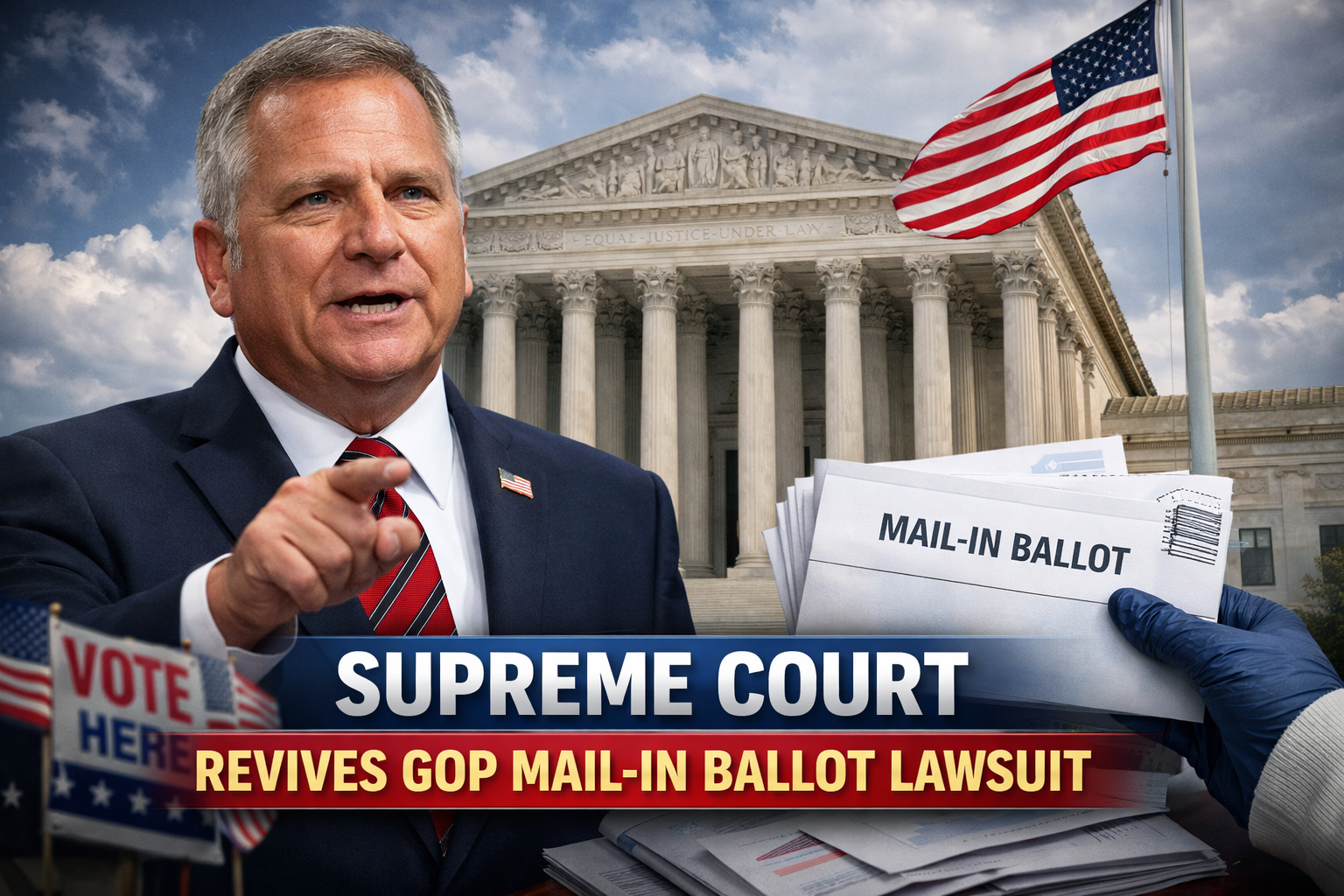
Supreme Court Greenlights GOP Lawsuit Challenging Mail-In Ballot Rules
WASHINGTON, D.C. — In a decisive 7–2 ruling on Wednesday, the U.S. Supreme Court cleared a major procedural hurdle in a Republican-led legal challenge to Illinois’ mail-in ballot counting rules, reviving GOP efforts to litigate ballot receipt deadlines that critics argue undermine election integrity.
The case, Bost v. Illinois State Board of Elections, centers not on the constitutionality of counting ballots received after Election Day but on whether a federal candidate has the legal right — known in law as Article III standing — to bring such a challenge in federal court.
Chief Justice John Roberts, writing for the majority, held that Republican Rep. Michael Bost of Illinois does indeed have standing to pursue judicial review of state rules that permit mail-in ballots to be accepted up to 14 days after Election Day if postmarked by that date. Roberts emphasized that candidates “have a concrete and particularized interest in the rules that govern the counting of votes in their elections,” regardless of whether those rules ultimately influenced the outcome of their races.
This decision reverses a series of lower-court rulings that had dismissed Bost’s challenge on standing grounds — including a district court and the Seventh Circuit Court of Appeals. Those courts found Bost lacked a cognizable injury because he won re-election decisively and thus could not show direct harm from the contested ballot rules.
What the Court Actually Decided
Wednesday’s ruling does not yet strike down Illinois’ ballot counting law. Instead, it allows the case to proceed in federal court on its merits — a significant development for GOP election law advocates. In essence, the Supreme Court acknowledged that federal candidates should not be barred from judicial review merely because they won or lost by a wide margin.
Justices Sonia Sotomayor and Ketanji Brown Jackson dissented, warning that expanding standing could flood federal courts with pre-election litigation and strain election administration. They argued that allowing candidates to sue without demonstrating direct, concrete harm weakens established judicial standards and could destabilize uniform legal requirements.
Conservative Legal Advocacy
Conservative legal analysts and GOP officials praised the decision as strengthening election accountability. From this viewpoint, allowing judicial review affirms that political actors affected by time, place, and manner rules should have access to the courts to contest laws that may erode voter confidence or alter election procedures.
The Republican National Committee and allied conservative groups have framed the broader effort against late-arriving ballots as defending the uniformity of Election Day itself — an argument rooted in the Constitution’s establishment of a single, fixed date for federal elections. This position has been echoed in several related federal challenges, including Watson v. Republican National Committee, which questions whether states can count ballots received after Election Day even when postmarked on time.
📌 Why This Matters for 2026 and Beyond
With midterm elections approaching in 2026 and presidential contests on the horizon in 2028, the authority of states to extend ballot receipt deadlines remains one of the most consequential election law questions before the high court. At least 16 states and the District of Columbia allow late-arriving mail-in ballots when postmarked by Election Day — a practice that Republicans argue extends the election beyond the date Congress designated.
Republicans contend that allowing ballots to trickle in long after polls close introduces uncertainty and can tilt close races. Conservative advocates maintain that adhering to strict deadlines helps ensure equal treatment of voters and prevents selective extensions that could disproportionately benefit one party.
Meanwhile, opponents of tightening ballot receipt deadlines argue that mail-in voting accommodates modern voting practices, citing postal delays and modern voter habits. They maintain that grace periods help ensure that eligible votes are counted without disenfranchising citizens who rely on the mail system.
⚖️ Broader Legal and Political Impacts
The Court’s decision to allow Bost’s challenge to move forward could open similar opportunities nationwide for candidates and political parties to contest election rules that they view as problematic. Legal observers suggest this might spur an uptick in pre-election litigation as campaigns prepare for federal deadlines.
Attorney Paul Clement, representing Bost, has argued that campaign candidates — regardless of their past election outcomes — invest substantial resources and political capital in preparing for elections and therefore deserve the right to challenge rules that affect vote-counting.
At its core, the case raises fundamental questions about state autonomy in election administration versus federal statutory authority — issues previously explored in cases involving election calendar uniformity and mail-in voting standards.