

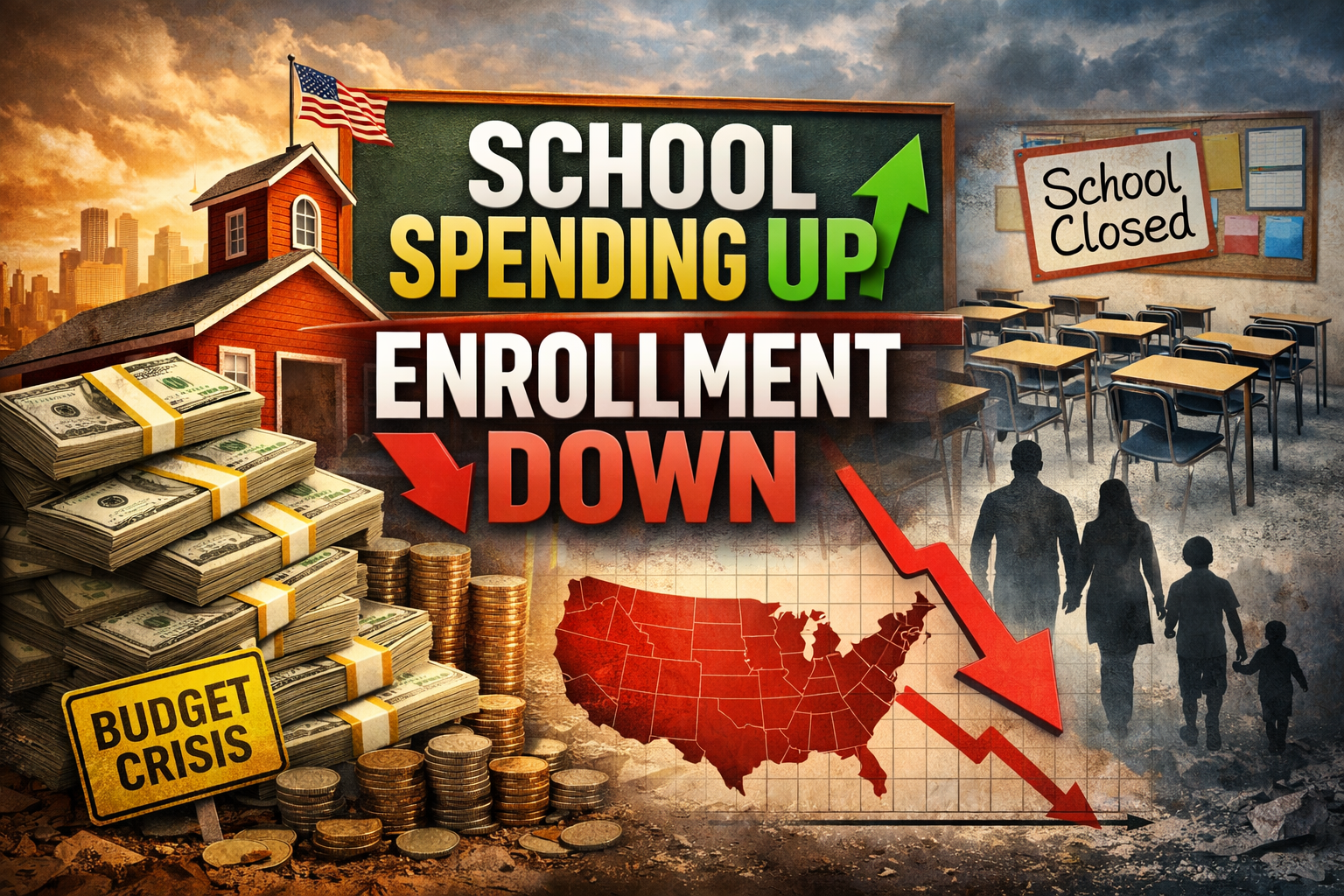
Across the United States, public school systems are increasing expenditures even as student enrollment continues a notable retreat, a trend raising questions about efficiency, accountability, and fiscal priorities in America’s education system.
Public school spending has climbed in recent years, driven by rising staffing costs, expanded administrative budgets, and pandemic-era relief funds that have not been fully wound down. Despite this growth in funding, enrollment remains in decline in many states and school districts—a paradox that educators, policymakers, and taxpayers are confronting as the next academic year looms.
Student rolls fell again this year. According to national figures, enrollment dropped about 1.3 percent this fall compared with a year ago, continuing a multi-year slide that predates the COVID-19 pandemic.
The disparity is not confined to isolated districts. On X (formerly Twitter), national coverage highlights this recurring theme:
📌 X Post:
“While school spending rises nationally, enrollment continues to decline.”
This post underscores growing frustration among educators and advocates who point to spiraling budgets alongside shrinking enrollment figures—a dynamic that defies typical funding models tied to student count.
Spending increases encompass teacher salaries, benefits, infrastructure, technology upgrades, and administrative expansions. In many states, per-pupil expenditures are at record highs, even as actual headcounts fall—a situation that has fiscal watchdogs asking whether public dollars are being deployed effectively.
One expert recently noted that staffing and operational costs have not adjusted in pace with declining enrollment, leaving districts with rigid cost structures while their revenue streams tighten.
Despite the rhetoric around more funding equating to better outcomes, some evidence suggests that increased spending has failed to reverse declines in academic performance or bolster enrollment.
Enrollment Declines Widespread
This trend is playing out in districts large and small:
-
In Hartford, Connecticut, district enrollment has dropped by more than 1,200 students in just one year, prompting contracts with private recruitment firms to stem the exodus and prevent further losses.
-
In California, hundreds of schools have lost significant portions of their student population, with some reporting more than a 20 percent drop since the pandemic.
-
In Los Angeles, the nation’s second-largest district, enrollment is substantially lower than two decades ago, placing sustained pressure on budget planning.
In Texas, Houston ISD’s board recently moved forward with plans to close or consolidate up to a dozen schools due to under-enrollment and related budget strains. Approximately 25 percent of campuses operate at less than half capacity, a symptom of prolonged demographic and administrative shifts.
Enrollment declines are tied to multiple factors:
-
Changing birth rates and demographic shifts, which long preceded the pandemic, have reduced the number of school-age children nationwide.
-
Policy choices and local conditions, including school choice options, charter expansion, and homeschooling trends, continue to draw students away from traditional public schools.
-
In cities like Houston, fear of enforcement measures and immigration policy changes have also contributed to families withdrawing children from public schools.
Fiscal Strain Meets Policy Debate
As districts contend with fewer students, the inflation-adjusted cost per pupil keeps rising. Conservative observers argue that this trend reflects deeper inefficiencies and misplaced priorities rather than a true commitment to student achievement.
While advocates for more funding emphasize the need for resources, critics counter that open-ended increases without accountability yield little academic benefit. They point to stagnant or declining standardized test scores and growing administrative overhead as evidence that money alone isn’t the solution.
The debate has also drawn political scrutiny. On social media and in public forums, parents and taxpayers are calling for transparent budget priorities, clearer links between funding and outcomes, and reforms that align spending with enrollment realities.
Looking Ahead
With enrollment projected by some research to continue shrinking through the decade, districts may face hard choices about consolidations, staffing adjustments, and program priorities. The push for school choice, including private schooling, charter expansion, and education savings accounts (ESAs), further complicates the funding landscape.
As these trends unfold, conservative voices are likely to emphasize fiscal discipline, parental choice, and accountability mechanisms to ensure that public education dollars are spent where they yield measurable results.
🔑 Keywords
-
school spending rise
-
enrollment decline
-
public education funding
-
national school enrollment
-
budget inefficiency
-
taxpayer accountability
-
per-pupil costs
-
district budget crisis
-
school choice impact
-
conservative education analysis