

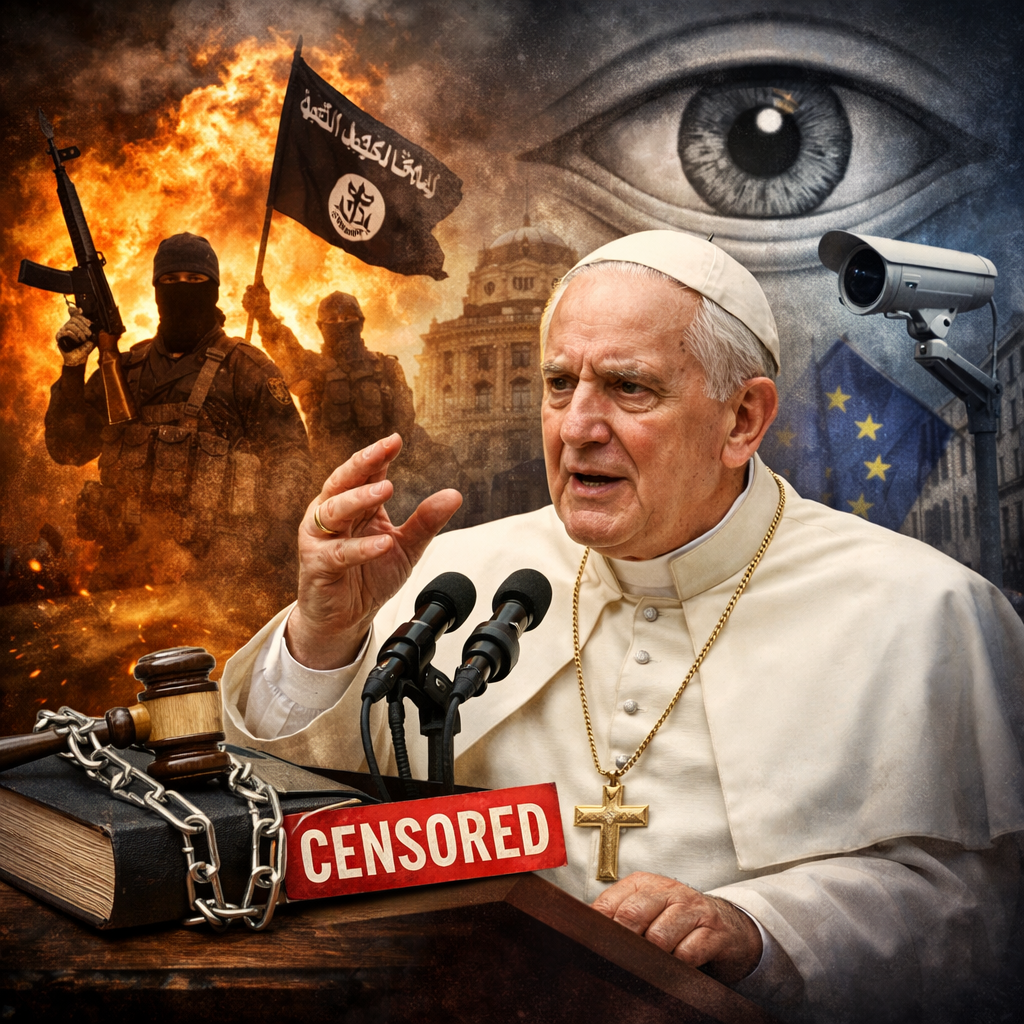
Pope Leo XIV issued a forceful warning this week against the twin threats of jihadist violence abroad and ideological repression in the West, arguing that both endanger human dignity and the foundational freedoms of civilization. Speaking before diplomatic representatives accredited to the Holy See, the pontiff departed from the cautious rhetoric often favored in international forums, choosing instead to confront what he described as a moral and cultural crisis unfolding on multiple fronts.
The Pope’s remarks emphasized that religiously motivated violence—particularly jihadist terrorism—remains a persistent and deadly reality, especially for Christian communities in parts of Africa, the Middle East, and Asia. He noted that attacks justified in the name of extremist ideology continue to destabilize societies, undermine peace efforts, and systematically target believers whose only offense is their faith.
Leo XIV rejected attempts to downplay or euphemize such violence, stressing that moral clarity is essential if the international community is to address the problem honestly. He cautioned against the temptation to excuse or rationalize acts of terror under the guise of political grievance or cultural misunderstanding, arguing that doing so ultimately emboldens perpetrators and abandons victims.
While addressing threats beyond Europe and North America, the Pope also turned his attention inward, issuing a sharp critique of what he characterized as “Orwellian-style” tendencies spreading throughout Western societies. He warned that speech once considered fundamental to democratic life is increasingly constrained by ideological enforcement, social pressure, and institutional gatekeeping.
According to Leo XIV, this erosion of free expression is not occurring through overt authoritarian rule, but through subtler mechanisms that punish dissent and stigmatize traditional moral viewpoints. He argued that citizens are being conditioned to self-censor, fearing professional, social, or legal consequences for expressing beliefs rooted in religion, natural law, or historical norms.
The pontiff expressed particular concern that Christian moral teaching is frequently treated as suspect or intolerant within public discourse. He warned that when faith-based perspectives are excluded from debate, pluralism itself is compromised, and democratic societies lose their capacity for honest self-examination.
Leo XIV framed these developments as part of a broader cultural shift away from objective truth. He suggested that when truth becomes subordinate to ideology, language itself is manipulated, and freedom becomes conditional upon compliance. Such conditions, he said, mirror the dystopian patterns described in twentieth-century totalitarian regimes, albeit adapted to modern sensibilities.
Addressing diplomats directly, the Pope urged governments to resist policies that marginalize religious conviction under the banner of progress or inclusion. He maintained that genuine tolerance does not require the suppression of conscience, and that societies hostile to faith inevitably weaken their own moral foundations.
The Pope’s comments also underscored the Vatican’s longstanding defense of religious liberty as a universal human right rather than a privilege granted by the state. He reiterated that freedom of worship and freedom of speech are inseparable, warning that restrictions on one inevitably lead to restrictions on the other.
Observers noted that Leo XIV’s language marked a notable departure from the ambiguity that often characterizes international discussions of extremism and censorship. His remarks were interpreted by many as a direct challenge to Western political and cultural elites who champion free expression in principle while limiting it in practice.
The speech comes amid ongoing debates in Europe and North America over hate-speech laws, digital censorship, and the role of religious institutions in public life. Critics of these policies argue that they are increasingly applied in ways that disproportionately affect traditional Christian teachings while ignoring hostility toward Christianity itself.
By placing jihadist violence and Western ideological repression within the same moral framework, Pope Leo XIV signaled that threats to human dignity can arise from both physical coercion and cultural control. He warned that societies unwilling to confront either danger risk surrendering their moral authority and their freedom.
The Vatican has not indicated whether the Pope’s remarks will translate into specific diplomatic initiatives, but the message was unmistakable. Leo XIV positioned the Church as a voice willing to speak uncomfortable truths, defending faith, freedom, and moral clarity in an era increasingly marked by confusion and constraint.