

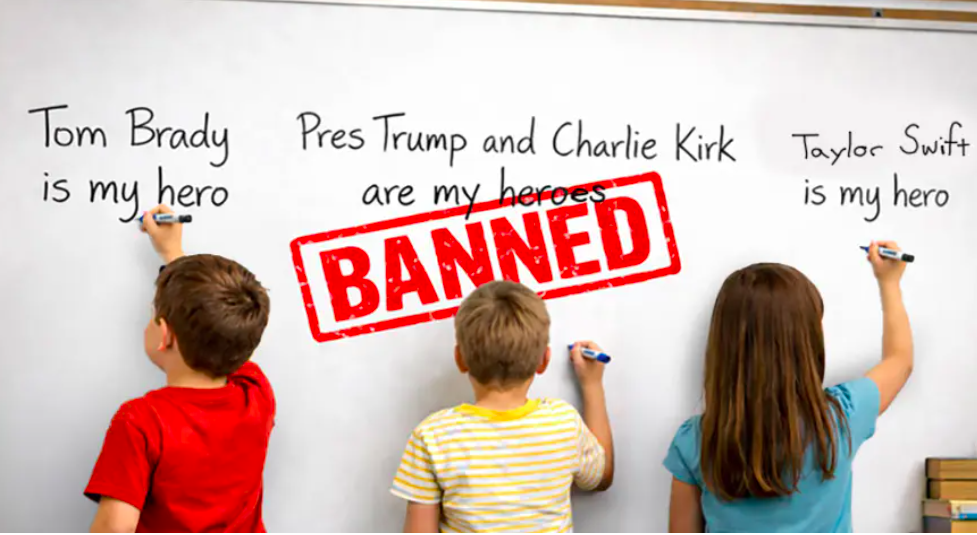
🚨 Teacher Bans Kids From Picking Trump, Jesus and Charlie Kirk as Role Models
EUREKA, Kan. — A civil-rights complaint filed this week has thrust a small Kansas elementary school into the national spotlight after parents alleged students were barred from publicly naming President Donald J. Trump, Jesus Christ and late conservative activist Charlie Kirk as role models during a classroom exercise.
The controversy centers on a sixth-grade “Find Your Voice” activity at Marshall Elementary School, where students were asked to identify who inspires them. According to the complaint, when a student chose Charlie Kirk, the school guidance counselor refused to allow the name on the classroom board, declaring he was “not a hero.”
Later, another student who selected former President Trump received the same treatment, the filing says, prompting the counselor to expand her prohibition to include all political and religious figures. A third student reportedly attempted to list Jesus as a role model and was similarly blocked.

📌 What Parents and Lawyers Are Saying
The legal complaint, filed by the American Center for Law & Justice (ACLJ) — a conservative, Christian-based legal advocacy organization — accuses the Eureka school district and Marshall Elementary of religious discrimination, political or viewpoint discrimination, retaliation and violation of students’ free speech rights.
ACLJ attorneys argue the school’s actions sent a clear message to children about whose voices are valued and whose are not. “By censoring students’ choices, the school not only ignored constitutional protections but fostered confusion about whose convictions matter,” the complaint states.
The complaint also cites an alleged school directive instructing students to bring concerns to educators rather than their parents — a claim that has sparked fierce criticism from conservative leaders who argue it infringes on basic parental rights.
🧑🏫 School’s Response
School officials have acknowledged awareness of the incident but have not issued a detailed public response to the complaint.
In an email to families shared with local media, Marshall Elementary Principal Stacy Coulter described the situation as “unintended confusion” during a learning activity and emphasized the school’s efforts to ensure activities are “positive and encouraging experiences for every student.”
Coulter declined to comment further on specifics involving staff due to privacy protections for students and employees. Superintendent Scott Hoyt reaffirmed the district’s commitment to communication but did not address disciplinary actions or clarify classroom policies regarding political or religious expression.
🏛️ Constitutional and Cultural Dimensions
The question at the heart of the controversy is not merely pedagogical but constitutional. The U.S. Supreme Court long ago affirmed that students do not “shed their constitutional rights to freedom of speech or expression at the schoolhouse gate.” Critics argue that Marshall Elementary’s selective ban on political and religious figures violates that principle by censoring particular viewpoints.
Additionally, the complaint contends the alleged instruction forbidding students to notify their parents of classroom incidents undermines fundamental parental rights — a point conservatives nationwide have increasingly highlighted as a red line in education policy.
📈 Conservative Voices Weigh In
Kansas Republican Rep. Ron Estes publicly condemned the incident, characterizing it as “alarming” and cautioned against teachers imposing their political beliefs on students. He stressed that public schools should be environments of open dialogue — not censorship.
Parents in Eureka have echoed these sentiments, with at least one family reportedly withdrawing children from the school rather than continue under what they describe as a restrictive atmosphere.
🧠 Broader Educational Implications
This case follows a broader national debate over the role of schools in shaping students’ civic awareness and moral frameworks. While some education experts advocate for neutral learning environments, parental advocacy groups and constitutional lawyers argue that suppressing students’ ability to publicly express admiration for specific figures — particularly when students are directly asked — is contrary to academic freedom and constitutional protections.
As the ACLJ’s complaint moves forward, legal analysts expect the case to draw attention from national civil-rights organizations and conservative media outlets that view the incident as emblematic of a wider cultural clash over free speech in schools.
🔑 High-Value Keywords
-
Teacher censorship
-
Free speech rights
-
Kansas elementary school
-
Political viewpoint discrimination
-
Religious expression
-
Parental rights
-
ACLJ lawsuit
-
Role model ban
-
Trump censorship
-
Charlie Kirk classroom