

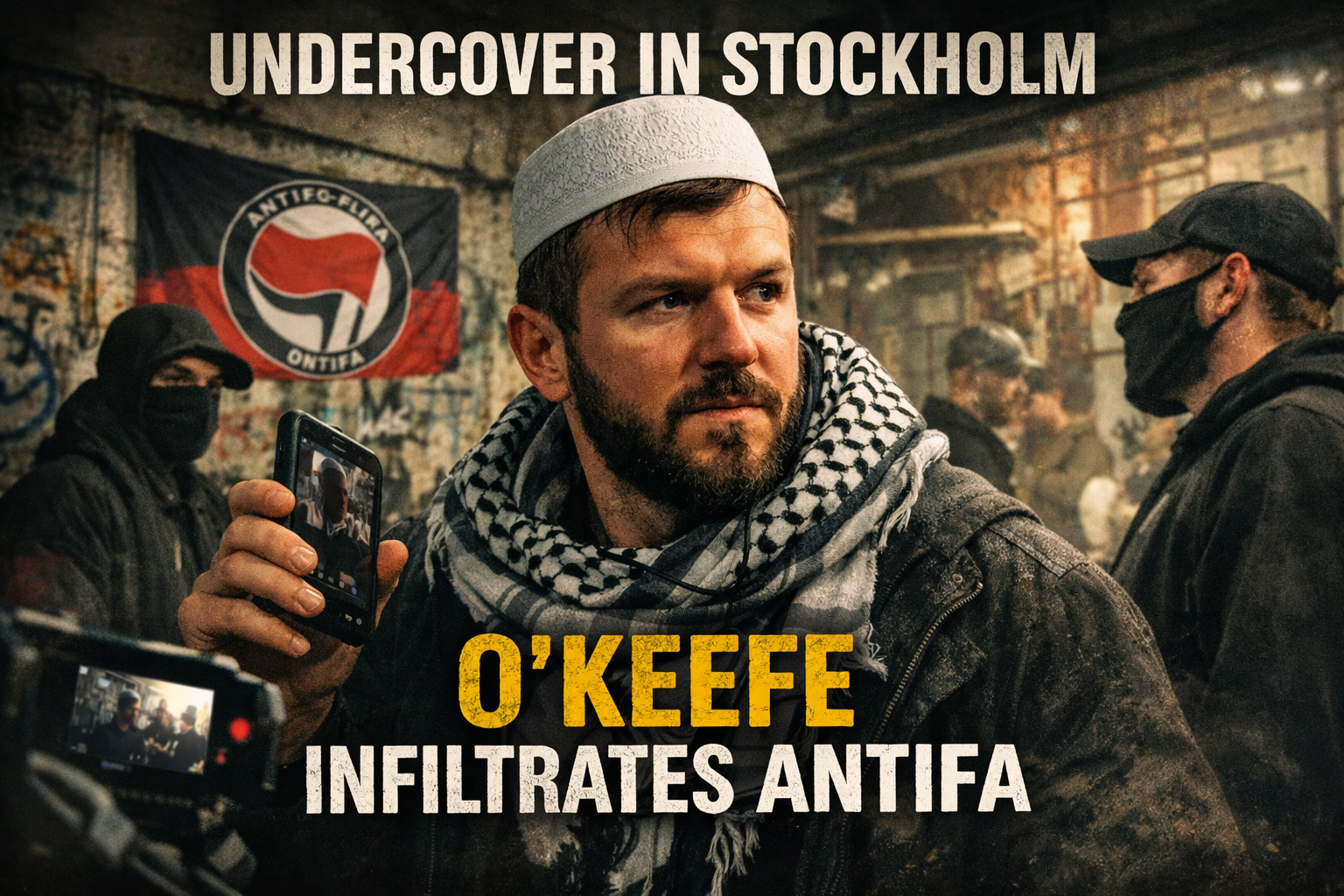
James O’Keefe, the conservative investigative journalist known for undercover reporting with O’Keefe Media Group, conducted a controversial new operation in Stockholm, Sweden, this week targeting the Antifa network known as “Cyklopen.” The mission, captured on hidden camera and streamed live, involved O’Keefe posing as a Muslim to gain entrance to the Antifa “cultural house” and document the organization’s inner workings.
In a brief announcement on X (formerly Twitter), O’Keefe declared the project “BREAKING,” stating he had gone undercover as a Muslim to infiltrate Antifa’s base in Stockholm. The livestream and accompanying footage were shared via his official social platform accounts, drawing significant attention and commentary.
On the live broadcast, which has been replayed thousands of times, O’Keefe described how he and Swedish citizen journalist Christian Peterson entered some of Stockholm’s most politically charged neighborhoods in pursuit of transparency and public accountability.
“We went to Riks headquarters in Stockholm, an alternative media organization labeled a national security concern by Swedish officials,” O’Keefe explained on camera inside the building. According to his presentation, opening doors that would otherwise have been closed required a disguise and the pretense of shared identity.
Once inside the Cyklopen headquarters, O’Keefe’s team observed symbols, slogans, and statements consistent with radical activist ideology. At one point in the recording, he can be heard attempting to blend in with local radical phrases like “F*ck ICE,” language he later said was part of maintaining the undercover cover story.
The operation was not without tension. O’Keefe recounted moments when members scrutinized him and other team members to verify whether they were truly committed to Antifa causes before permitting them continued access.
Although the full extent of what was captured on video has yet to be released in edited form, initial livestream footage shows interaction with group members who are confident enough in O’Keefe’s assumed identity to offer a guided tour of the headquarters.
Conservative observers have pointed to this undercover work as evidence of a larger network of activist coordination, while critics argue that such undercover approaches inevitably influence interactions and may not provide complete context. Debate around methodology is ongoing, though the video itself has become a focal point for discussion on activist organization transparency.
Notably, O’Keefe’s approach echoes earlier investigative work by conservative journalists such as Andy Ngo, who has documented Antifa demonstrations in the United States. Ngo’s reporting has often been contentious, with critics questioning his framing and media outlets debating whether his documentation accurately captures Antifa activity.
O’Keefe’s supporters on social media have framed the Stockholm operation as a necessary exposure of leftist activist coordination, especially given that many mainstream outlets have not extensively reported on the content of the livestream or subsequent videos. They argue that conservative investigative journalism fills gaps left by larger media networks reluctant to scrutinize left-leaning activism.
Critics of O’Keefe have been quick to claim that undercover operations blur ethical lines, though those critiques often come from progressive commentators who tend to dismiss concerns over activism’s influence on public life. In contrast, conservative analysts applaud the willingness to document and reveal internal dynamics of groups like Antifa, which they see as politically disruptive.
As of this writing, the full edited version of the Stockholm footage and accompanying analysis from O’Keefe Media Group is expected to be released on the group’s official video channels in the coming days. The initial livestream, however, remains available via the official broadcast and social media clips shared by followers.
Public reaction has been swift online, with many conservatives praising the boldness of the undercover operation and others calling for further exposure of activist networks internationally. Whether this leads to policy discussion or legal implications for Antifa groups in Sweden remains speculative, though supporters of O’Keefe’s work contend it bolsters calls for transparency in activist organization operations abroad.