

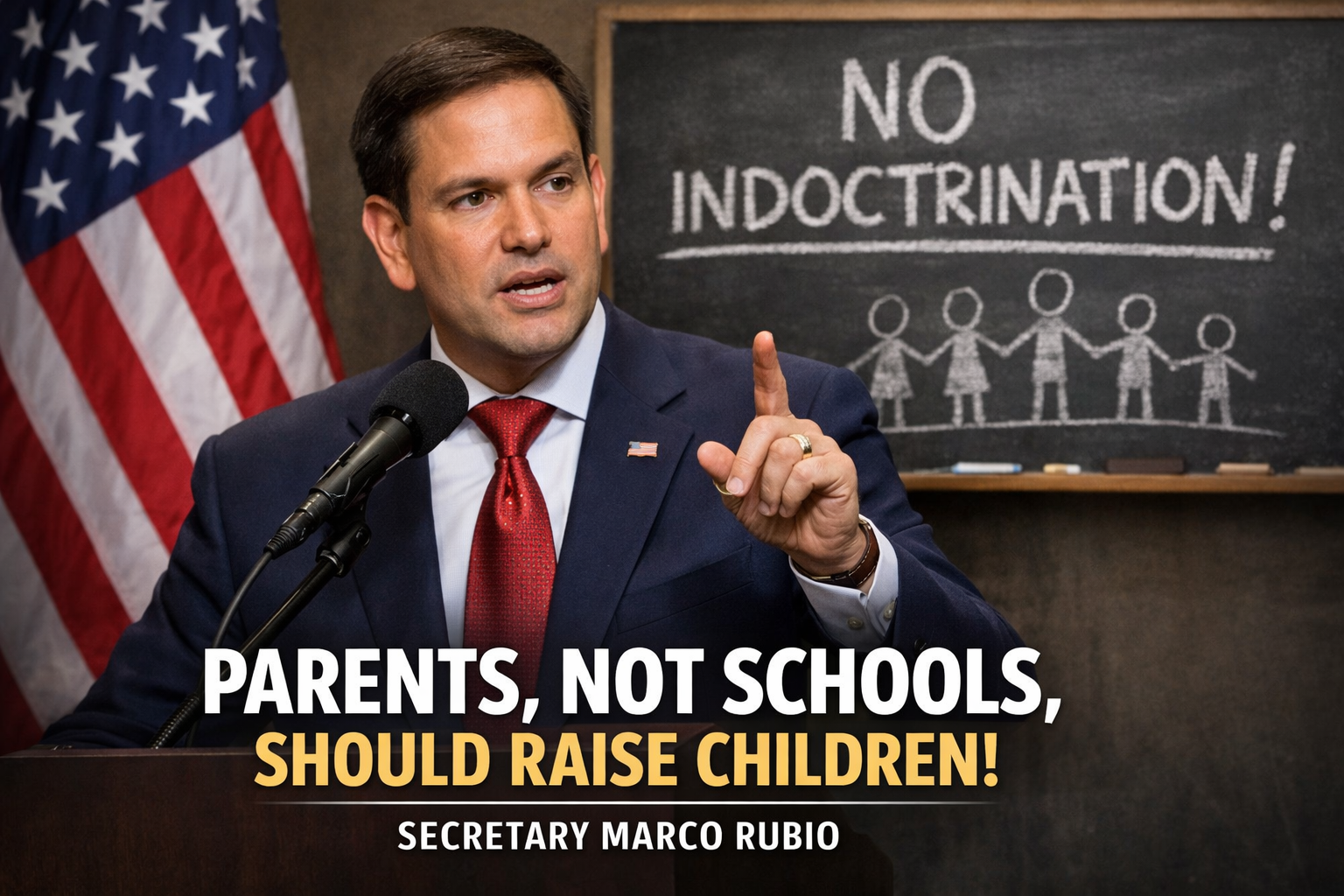
Secretary Rubio: “Parents, Not Schools, Should Raise Children — No Indoctrination, No Government Control”
Secretary of State Marco Rubio delivered an emphatic statement this week on the fundamental role of family in child-rearing, asserting that government and public schools should not supplant parents in shaping children’s values and character. His remarks, made at a town-hall event in Florida, have ignited debate across political and educational circles.
Rubio’s message centered on the proposition that “It’s neither the government nor the schools’ job to raise children. They’re there to teach.” He emphasized that, while schools have a legitimate function in imparting academic knowledge, they do not have the authority — nor should they seek — to supplant parents as moral and cultural guides.
View this post on Instagram
At the heart of Rubio’s remarks was a critique of what he characterizes as ideological influence in classrooms. “We cannot tolerate turning schools into indoctrination centers,” he declared, arguing that when educational institutions expand their purposes beyond instruction into sociopolitical advocacy, they undermine family autonomy. According to Rubio, this trend reflects an overreach reminiscent of Marxist tactics, where authority structures persuade young people to “listen to us” rather than to their families.
The secretary’s comments resonate with broader elements of the parental rights movement, a coalition of activists, lawmakers, and families advocating greater transparency and control over educational curricula. This movement has gained public attention since 2022, particularly following the passage of the Florida Parental Rights in Education Act, which limits classroom instruction on sexual orientation and gender identity without explicit approval from parents.
The Greatest Upset in Sports History—Here’s the Real Story
Rubio also criticized the federal government when attaching funding conditions to education programs. “If you don’t let boys play in girls’ sports, we will take away your school lunch money,” he said, referencing concerns that federal dollars are sometimes contingent on compliance with social policy mandates. His rhetoric echoed a longstanding conservative argument that federal incentives can function as de facto mandates.
Educational choice and competition were recurring themes in Rubio’s agenda. He reaffirmed support for school choice, vocational pathways, and expansion of career and technical education, saying these options empower parents and students while reducing the influence of bureaucratic education systems. Rubio has also backed reform of college accreditation standards to eliminate what he sees as ideological metrics such as Diversity, Equity, and Inclusion (DEI) requirements.
Rubio’s stance reflects a broader consensus among conservative thinkers that federal involvement in education has expanded beyond its constitutional remit. Cato Institute scholar Neal McCluskey, whom Rubio cited positively, has argued that the Department of Education is unconstitutional, ineffective, and costly — advocating for its elimination. McCluskey notes that education was largely a state and local responsibility before the department’s creation in 1980, and that centralization has yielded stagnant academic outcomes despite increasing federal spending.
Critics of federal educational policymaking often point to national assessments showing minimal academic improvement over recent decades, despite substantial increases in federal funding. Such data are central to the argument that federal authority should be scaled back and local decision-making scaled up. While critics on the left dismiss these arguments as simplistic, prominent voices on the right view them as evidence of systemic failure.
In addition to domestic education policy, Rubio has weighed in on international educational programs administered by the State Department’s Bureau of Educational and Cultural Affairs. After assuming office in 2025, he assumed oversight of initiatives such as Fulbright-Hays, signaling a repositioning of the U.S. role in cultural and academic exchange.
Social media reaction to Rubio’s speech illustrates the intensity of public engagement with these ideas. Clips and reels circulating on platforms like Instagram and X captured Rubio’s remarks on parental authority and the boundary between school and home. Commenters on these posts largely supported his admonition against what they perceive as politicized education, highlighting a widespread grassroots appetite for parental empowerment in schooling decisions.
Opponents, however, argue that Rubio’s language risks oversimplifying complex educational challenges and could discourage necessary discussions about race, equity, and social dynamics in classrooms. They contend that educational institutions have a responsibility to prepare students for modern societal realities. Yet supporters counter that genuine preparation can occur without ideological advocacy, and that parents — not bureaucrats — should decide the moral frameworks shaping young minds.
Rubio’s comments come amid a broader national debate over educational philosophy, parental rights, and the future role of public schooling in American society. As legislative proposals and executive actions continue to emerge, the tension between federal authority, state autonomy, and family prerogatives is likely to remain a defining issue in the education policy arena throughout 2026.
🔑 High-Value Keywords
-
parental rights
-
school choice
-
education reform
-
Marco Rubio
-
federal education policy
-
indoctrination debate
-
family autonomy
-
vocational training
-
curriculum transparency
-
state vs federal control