

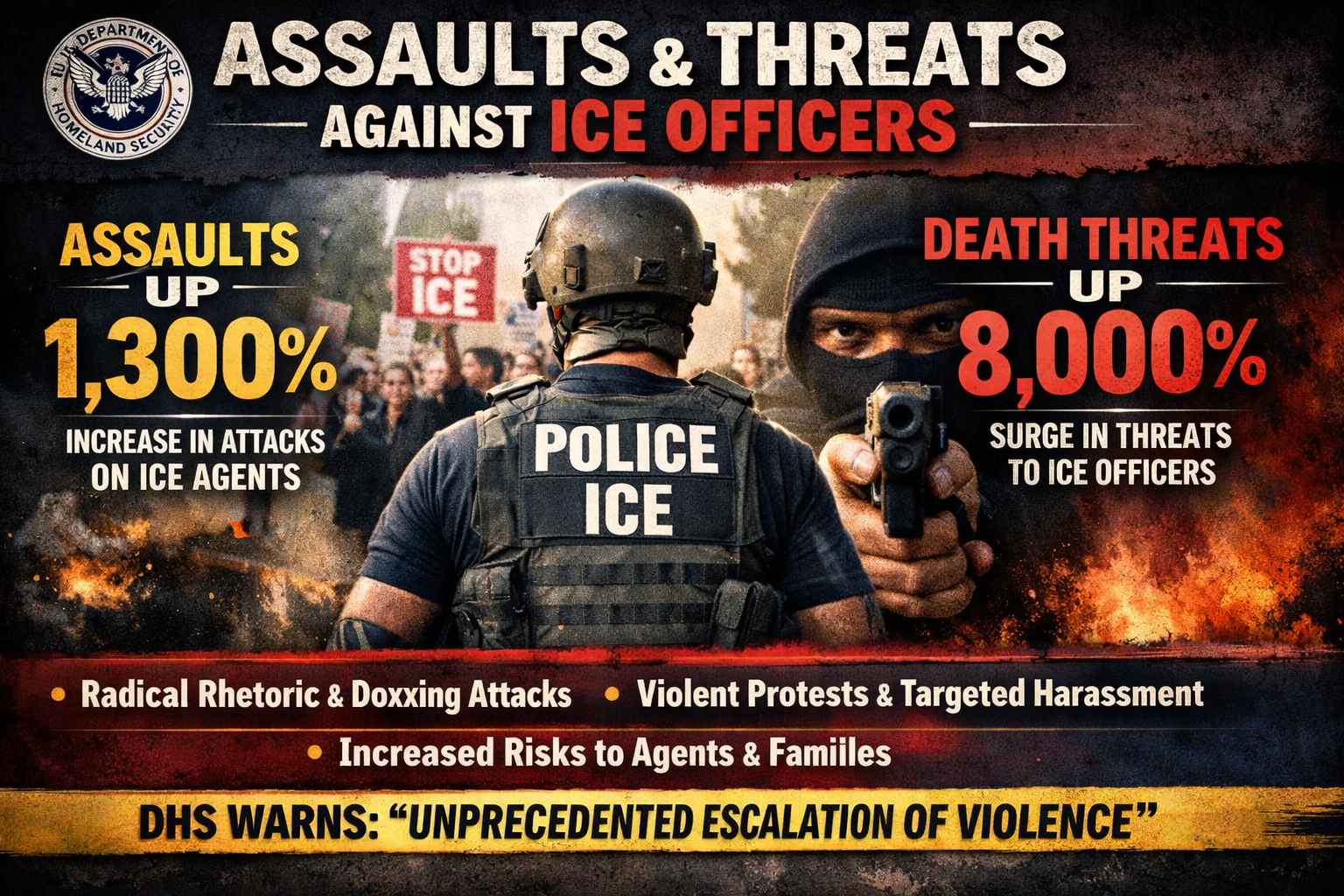
In a startling update this week, the U.S. Department of Homeland Security (DHS) announced what officials describe as a dramatic escalation in violence and intimidation directed at U.S. Immigration and Customs Enforcement (ICE) officers nationwide. The agency’s data shows that assaults on ICE officers have increased by 1,300%, while death threats targeting those officers and their families have surged an astonishing 8,000% compared with recent baseline figures.
Homeland Security leadership attributed the spike to what they call “radical rhetoric” by politicians in so-called sanctuary jurisdictions and aggressive activist networks that explicitly target immigration enforcement personnel. DHS leaders argue that this environment not only endangers federal law enforcement officers but also undermines public safety.
Assistant Secretary for DHS Tricia McLaughlin stressed the severity of the trend in a statement to national outlets. She cited not only threats and assaults but also doxxing campaigns aimed at exposing the personal information of agents and their families, an activity she said “endangers American citizens who have sworn to uphold the law.”
A social media post from the official ICE account on X underscores the agency’s concern: “Assaults on ICE are up over 1,300% and death threats are up over 8,000% — the hostile environment our officers endure is unprecedented.”
Federal law enforcement officers report that threats have grown not merely in volume but in intensity. Multiple officers have reported threats to their families and stalking behavior associated with online campaigns that distribute personal details of agents, a practice that civil liberties advocates warn could have chilling effects on law enforcement recruiting and retention.

In Minneapolis and several other cities where large federal immigration operations are underway, clashes between ICE officers and demonstrators have become increasingly frequent. DHS asserts these tensions have contributed to the broader pattern of violence against its agents.
Federal agents in Minneapolis were deployed as part of Operation Metro Surge, a campaign DHS described as the largest immigration enforcement undertaking in recent U.S. history. The operation — aimed at removing criminal illegal aliens and enforcing federal immigration statutes — coincided with intense protest activity and confrontations that local officials and activists have portrayed as civic resistance.
One flashpoint in these clashes has been the fatal incident involving Renee Good, who was killed by an ICE agent in Minneapolis on January 7, 2026, during a federal enforcement action. Video analyzed by independent media showed the ICE agent firing his weapon after Good’s vehicle reportedly moved toward the officer and other enforcement personnel. Competing narratives about the incident have fueled heightened emotions on both sides of the debate.
Federal officials have countered sharply critical local political rhetoric in recent weeks. DHS Secretary Kristi Noem has publicly condemned inflammatory comments made by some Democratic leaders, insisting that they have contributed to an atmosphere that inflames tensions and emboldens violent actors.
In response to the surge in threats, federal security protocols for ICE officers have been reinforced. Measures include increased coordination with the Department of Justice to prosecute individuals who threaten federal employees, enhanced protective procedures for officers’ families, and internal training to address online harassment and doxxing.
Republican lawmakers on Capitol Hill have cited the data as evidence of a crisis that necessitates stronger federal action. Several members of Congress have introduced or supported legislation intended to bolster protections for federal law enforcement officers and punish doxxing campaigns that risk their safety.
Meanwhile, critics argue that the Trump administration’s aggressive immigration enforcement has exacerbated community tensions, creating flashpoints that can result in violence on both sides. Even so, DHS officials maintain that refusing to enforce immigration laws emboldens criminal elements and places greater burdens on local communities.
Public safety experts point out that any sustained rise in violence against law enforcement is a serious concern for a functioning republic. They stress the importance of maintaining respect for legal authority while also advocating for reforms that reduce friction between federal enforcement agencies and the communities they serve.
As the national conversation continues, policymakers, law enforcement leaders, and community advocates are likely to debate both the causes and solutions to this surge in hostility toward ICE officers. For now, the sharp increases documented by DHS serve as a stark marker of the volatile intersection between immigration policy, political rhetoric, and public safety in the United States.
-
ICE officer assaults
-
DHS death threats surge
-
immigration enforcement violence
-
sanctuary politician rhetoric
-
federal law enforcement danger
-
ICE doxxing crisis
-
Operation Metro Surge
-
Renee Good Minneapolis
-
national security threats
-
law enforcement protections