
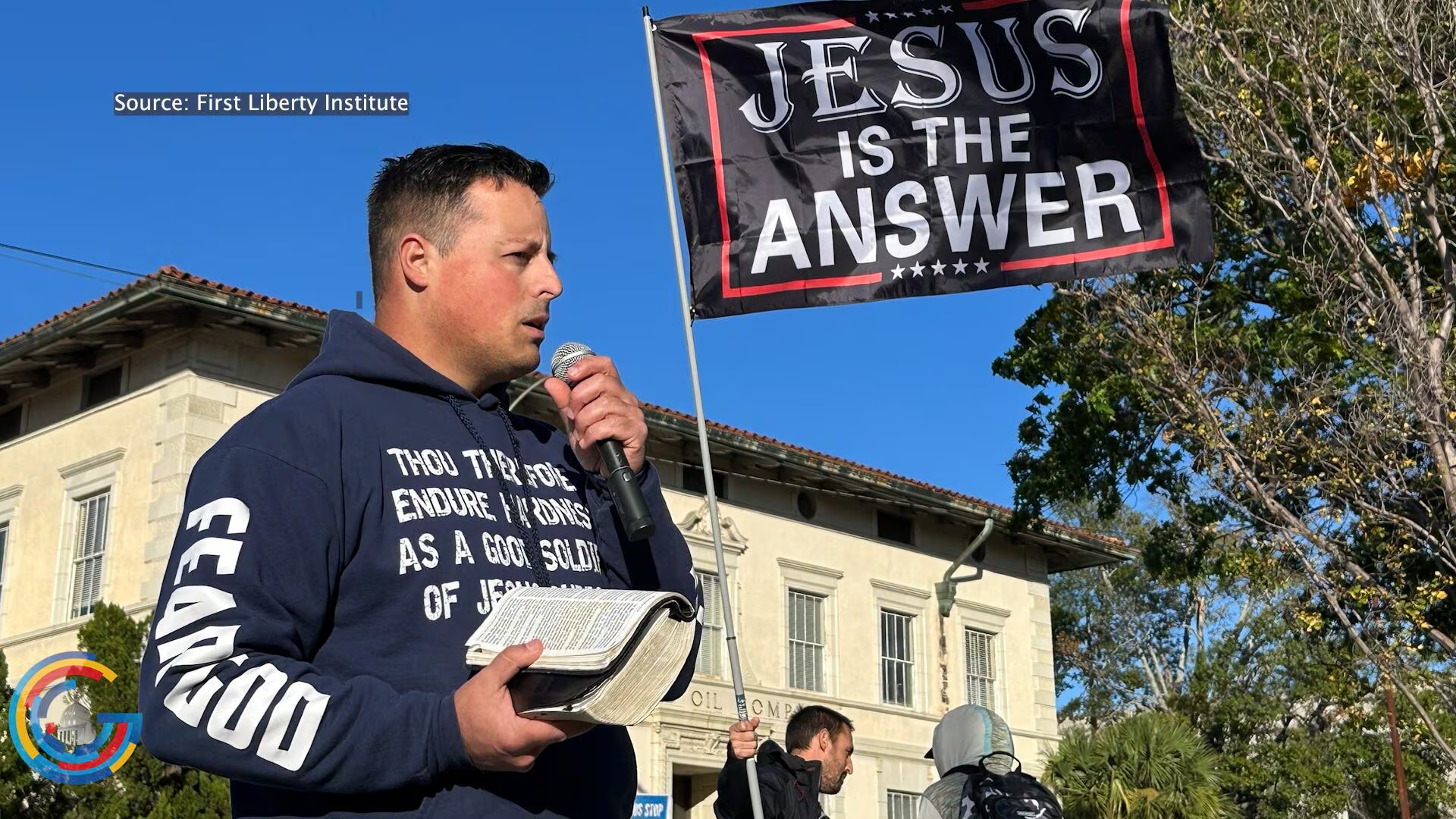
Supreme Court Revives Preacher’s Free Speech Lawsuit
The United States Supreme Court unanimously voted to allow a lawsuit, filed by Gabriel Olivier, to move forward with a lawsuit against the city of Brandon, challenging a protest ordinance that restricted his ability to preach outside a local amphitheater. The ruling revives his lawsuit, reversing lower court decisions that barred the suit following his previous conviction.
The dispute centers on whether local restrictions stray into forbidden territory when they limit speech that happens just outside a government-run venue. The decision to revive the case signals that the high court sees unsettled constitutional questions worth reexamining.
The ruling revives his lawsuit, reversing lower court decisions that barred the suit following his previous conviction.
Washington, DC – “This is not only a win for the right to share your faith in public, but also a win for every American’s right to have their day in court when their First Amendment rights are violated,” said Kelly Shackelford, President, CEO, and Chief Counsel for First Liberty Institute.
What Happened
A preacher sued after being told he could not engage in certain forms of speech near an amphitheater owned or operated by a municipality. The town argued its rules were meant to keep the venue safe, orderly, and focused on scheduled events rather than to single out a speaker or viewpoint. The preacher claimed the rules violated his First Amendment right to speak and to evangelize outside the venue.
Lower courts split over how to treat the area immediately around municipal performance spaces, with judges wrestling over forum doctrine and the government’s ability to regulate speech on or near public property. Some judges treat outdoor performance sites and their immediate surroundings as less protected, while others insist that proximity to a stage does not mean speech loses constitutional protection. Those different approaches left gaps the Supreme Court appears ready to close.
The core legal tension is classic: how far can a government go in regulating time, place, and manner of speech without engaging in viewpoint discrimination? Governments can impose reasonable, content-neutral restrictions if they are narrowly tailored and leave open ample alternative channels for communication. But when rules single out religious speech or are applied unevenly, courts are more likely to find constitutional problems.
Why It Matters
A ruling that strengthens protections for speech just outside government-managed venues would have implications for municipalities, event organizers, and individuals who want to engage with audiences before or after ticketed events. Cities may need to rethink crowd control policies, permit regimes, and the wording of ordinances to avoid creating rules that could be read as targeting specific messages. For religious speakers, a favorable decision would reinforce the idea that public spaces adjacent to civic facilities remain arenas for protected expression.
The case also matters for event organizers who worry about safety, traffic, and disruption when extra speakers, leafleters, or protesters gather near an amphitheater. Courts often balance those administrative concerns against constitutional protections, and the outcome could recalibrate that balance. Expect municipal lawyers to watch the ruling closely and to prepare to rewrite policies to survive constitutional scrutiny.
Beyond practical policy, the dispute touches on broader themes about how much space the state can claim around venues it controls. Public assemblies, concerts, and civic events take place in spaces managed for public benefit, yet the surrounding sidewalks, plazas, and parking lots traditionally belong to the public. The Supreme Court’s view on where the line should be drawn will guide future disputes about access and control.
Observers also note that the court’s willingness to take up the question reflects its ongoing interest in clarifying First Amendment boundaries. With divergent rulings below, the justices have an opportunity to offer clearer rules about when and how local governments can regulate speech tied to municipal venues. Whatever the outcome, the decision will land as a benchmark for lower courts wrestling with similar fact patterns.
The attorney general’s office, municipal attorneys, civil liberties groups, and religious liberty advocates are likely to weigh in as the case proceeds. Briefing and oral argument will give the high court the chance to address practical details and the doctrinal framework at the same time. The public and legal communities will watch whether the ruling favors broader protections for off-stage speech or grants more leeway to local governments seeking to manage event spaces.
For now, the revival of the lawsuit is a reminder that disputes over speech and public space are rarely settled once and for all. When public life intersects with expressive activity, courts become the arena in which competing values—order, safety, and free expression—are worked out. This case will be a key chapter in that ongoing national conversation about how to preserve both civic order and constitutional liberty.