

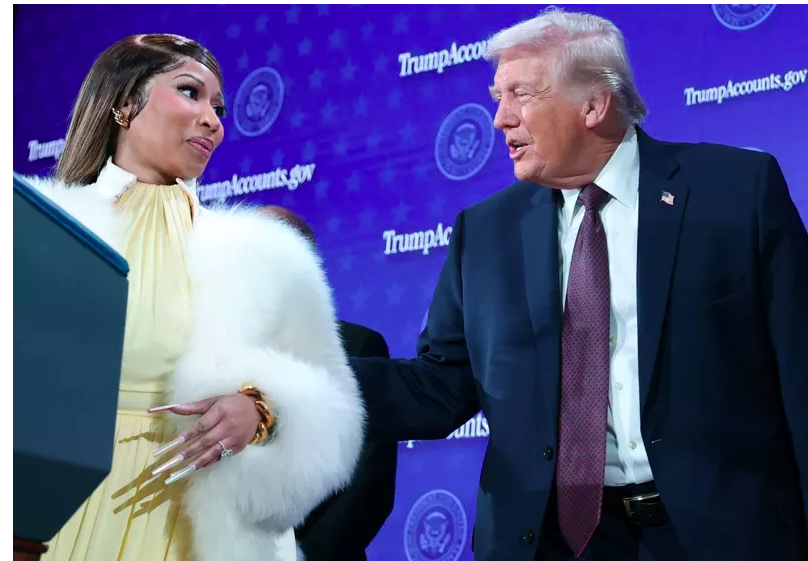
Nicki Minaj Calls Out Christian Voters In Stark Statement
Nicki Minaj, a high-profile artist with a huge platform, made a blunt remark that has the internet talking. In a recent public comment she said any Christian who votes for the Democratic Party again “is a fool.” The line landed like a splash of cold water across social media and political feeds.
“Any Christian who votes democrat again is a fool. They’re showing people that it’s ok to disrupt a church during worship. This is how they truly feel about you. The veil is lifted. No morals. No integrity,” Minaj wrote in a post on X Sunday as the 68th annual Grammy Awards show was underway.
A Swift, Stark Declaration
The comment is short, sharp, and impossible to ignore when it comes from someone with Minaj’s reach. She didn’t unpack policy or debate specifics; the message was a moral verdict aimed at a religious identity and a political choice. That directness explains why reactions ranged from applause to alarm within minutes.
Celebrity pronouncements like this tend to act as accelerants, not explanations. Fans amplify soundbites both for agreement and outrage, and the nuance is usually lost in the firestorm. That dynamic is part of why a simple sentence can become a national talking point overnight.
Ripples And Reactions
Responses have come from many corners: fellow artists, political commentators, faith leaders, and everyday social media users. Some praised the candor, framing it as courage to name a perceived conflict between faith and party positions. Others warned that calling fellow believers fools risks deepening divides and shuts down conversation instead of opening it.
Past polls show religious identity can intersect with political preferences in complex ways, so outsiders offering hard judgments may miss the messy reality people face. Faith communities are not monoliths; within churches there are wide-ranging views on economics, justice, social issues, and governance. That complexity is why sweeping statements are often both confronting and incomplete.
There is also a separate conversation about celebrity influence and responsibility. When public figures weigh in on politics, they shape discourse, especially among younger fans who treat cultural icons like guideposts. Critics argue that influence should be paired with context and information, not just forceful pronouncements.
Legal and civic experts note that freedom of speech protects these kinds of statements, but protection does not equal immunity from consequences. Artists and influencers have to live with the fallout, positive or negative, when they mix faith with partisan claims. Often the backlash is part of the bargain of being loud in the public square.
For Christians who felt singled out, the comment cut deep because it framed a political alignment as a moral failure. Some church leaders pushed back gently, urging humility and dialogue instead of public shaming. Others doubled down on political critique, saying spiritual convictions should shape voting choices more than party loyalty.
Beyond religious voters, political strategists will note the practical impact of such statements during an election cycle. Messaging that paints whole groups as foolish can alienate undecided voters and rally bases at the same time. In short campaigns, tone matters almost as much as policy points.
On the personal level, Minaj’s remark adds to a long history of artists wading into politics with mixed results. Some figures have shifted public opinion, while others have sparked controversies that overshadow their art for weeks. Either way, the incident is a reminder that fame amplifies every line spoken and every stance taken.
At the end of the day, the exchange exposes a broader social truth: identity, faith, and politics are tightly entangled and rarely yield to tidy labels. Conversations that respect complexity are more likely to persuade than those that deliver verdicts. Whether you agree with the line or not, the reaction it produced says as much about the country as the comment itself.