

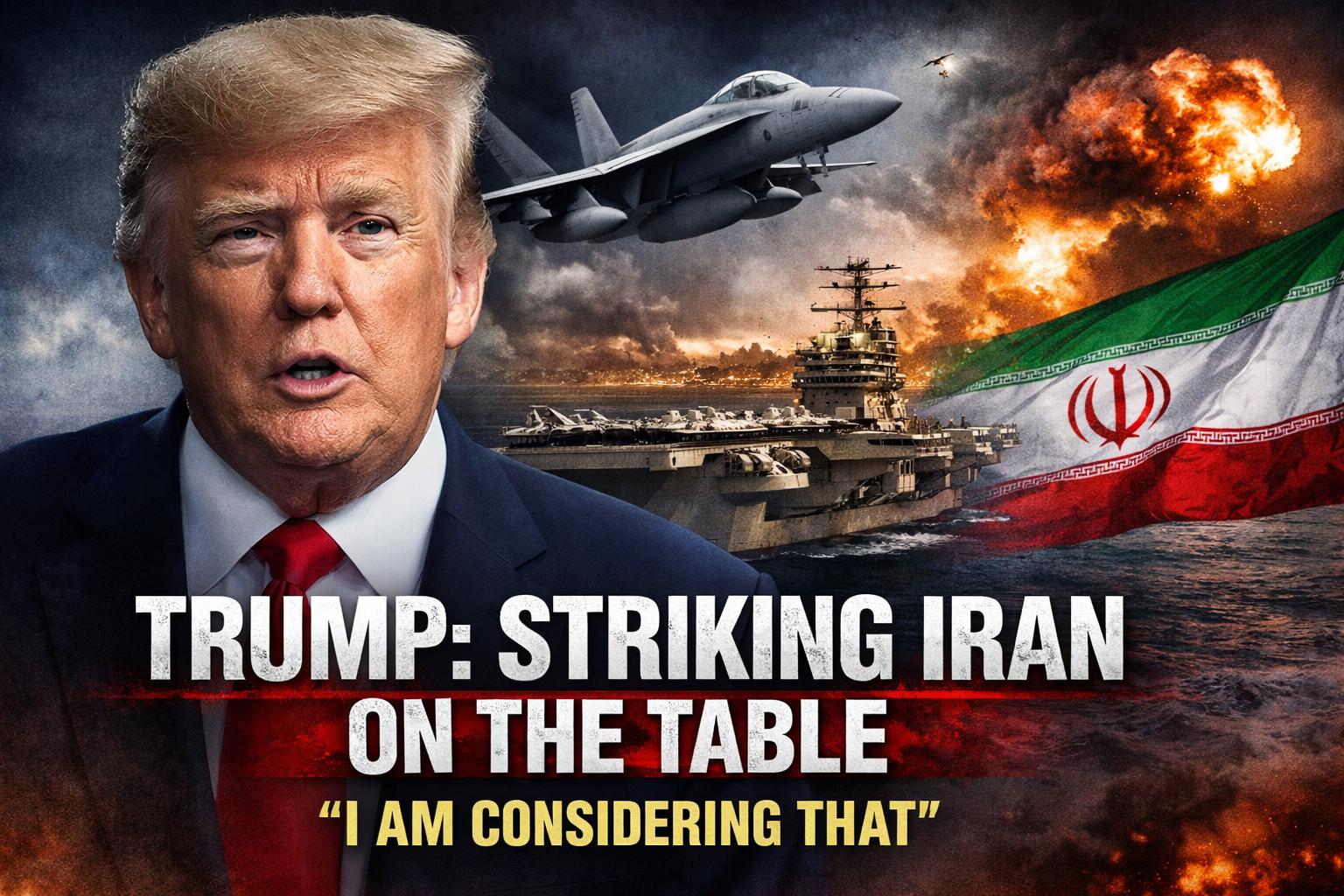
📰 President Trump Confirms Iran Strike Option: “I Am Considering That”
President Donald Trump confirmed Friday that a military strike against Iran remains “on the table” as negotiations over Tehran’s nuclear program continue amid escalating tensions in the Middle East. Trump’s remarks marked a significant escalation in U.S. diplomatic and military posture toward Iran, signaling that pressure tactics could include limited force to compel Tehran to agree to tough terms.
Rising Tensions, Rising Stakes
At a White House press briefing, Mr. Trump was asked whether a limited strike against Iran was under serious consideration. “I guess I can say I am considering that,” the president replied, leaving open the possibility that military force, alongside diplomacy, could be used to compel Iranian compliance on nuclear non-proliferation.
Trump’s statement followed a stern warning issued Thursday at a Board of Peace meeting in Washington that Iran had a 10-to-15 day window to agree to a deal or risk “really bad things” happening.
In recent weeks, U.S. forces have ramped up deployments in the region, including the arrival of a second aircraft carrier strike group and additional combat aircraft. These moves underscore Washington’s readiness to act if diplomacy fails, while also reinforcing deterrence against Iranian aggression.
Strategic and Economic Consequences
Markets reacted sharply to indications that military action could be imminent. On Friday, the Dow Jones Industrial Average fell over 260 points as oil prices surged nearly 2%, reflecting investor concerns about instability in the Strait of Hormuz — through which a significant share of global oil supply passes.
This market response reflects broader geopolitical risk: even the threat of conflict can unsettle global energy markets and capital flows, whether or not kinetic military action ultimately occurs.
Prediction Markets and Public Expectations
Contrary to narrative inflation in some outlets, marketplace data suggests that, as of this week, probabilities for an open U.S. strike before late February remain relatively modest, despite political rhetoric and military buildup. Trading on Polymarket indicates a 63% chance that such an attack occurs before the end of March. The odds of some form of U.S. strike on Iran by late February ranged in the teens — far from a foregone conclusion.
Such markets are not predictive in the strict sense — they are forward-looking bets that reflect traders’ expectations — but they do suggest that investors and geopolitical risk analysts are not universally pricing in an immediate outright strike. That nuance is essential for informed analysis.
Diplomatic Track and Iranian Stance
Iran’s appeal to maintain a nuclear enrichment capability remains a core sticking point in the negotiations. Tehran insists it has not received explicit demands to cease all enrichment activity, even as U.S. and allied leaders press for stringent limits on uranium enrichment to avert weaponization.
Iran’s deputy foreign minister, Abbas Araghchi, reiterated this point in interviews, pushing back against interpretations of U.S. demands and framing diplomacy as ongoing.
Iran has also engaged in unusual military activity in the Strait of Hormuz, temporarily closing it during live-fire drills — a move the regime calls routine but which analysts say adds to regional nervousness about escalation.
International Frictions
Not all U.S. allies are on board with the most aggressive tactics. Reports emerged Friday that the United Kingdom, under Prime Minister Keir Starmer, refused to grant permission for the U.S. to use RAF bases for any strike on Iran. This move highlights fissures in Western alignment, even as Washington pushes a firm line on Iran’s nuclear ambitions.
Strategic Logic: A Calculated Choice, Not Impulsive Action
Within conservative foreign-policy circles, Trump’s willingness to publicly confirm that striking Iran remains under consideration is seen as part of a strategy of deterrence: by making U.S. resolve transparent, Tehran faces heightened political and psychological pressure to compromise. This mirrors successful adversary deterrence strategies historically employed by strong states facing hostile nuclear-armed rivals.
It is also a reminder that diplomatic leverage often depends on the credible threat of escalation — not simply negotiations in isolation.
Iranian Response and Regional Repercussions
Tehran has publicly stated it does not wish to initiate conflict. However, Iranian leaders have also warned that any attack would be met with retaliation against U.S. assets within the region.
Joint Iranian-Russian drills and repositioning of drone assets in the Gulf of Oman have fed concerns that Tehran is hedging against potential conflict even as it sits at the negotiating table.
Domestic and Global Reactions
A range of voices inside the U.S. has weighed in. Republicans like Sen. J.D. Vance have underscored hard red lines on Iranian nuclear capabilities, while other leaders stress the necessity of constitutional war powers debates should actual kinetic operations be ordered.
Across the globe, Iran-diaspora protests and anti-regime activism continue, showing that the internal dynamics within Iran itself remain a significant factor in broader regional developments.
🔑 High-Value Keywords
-
Trump Iran strike
-
Middle East tensions
-
nuclear negotiations
-
prediction markets
-
Strait of Hormuz
-
aircraft carrier deployment
-
Tehran enrichment
-
U.S. deterrence strategy
-
geopolitical risk indicators