

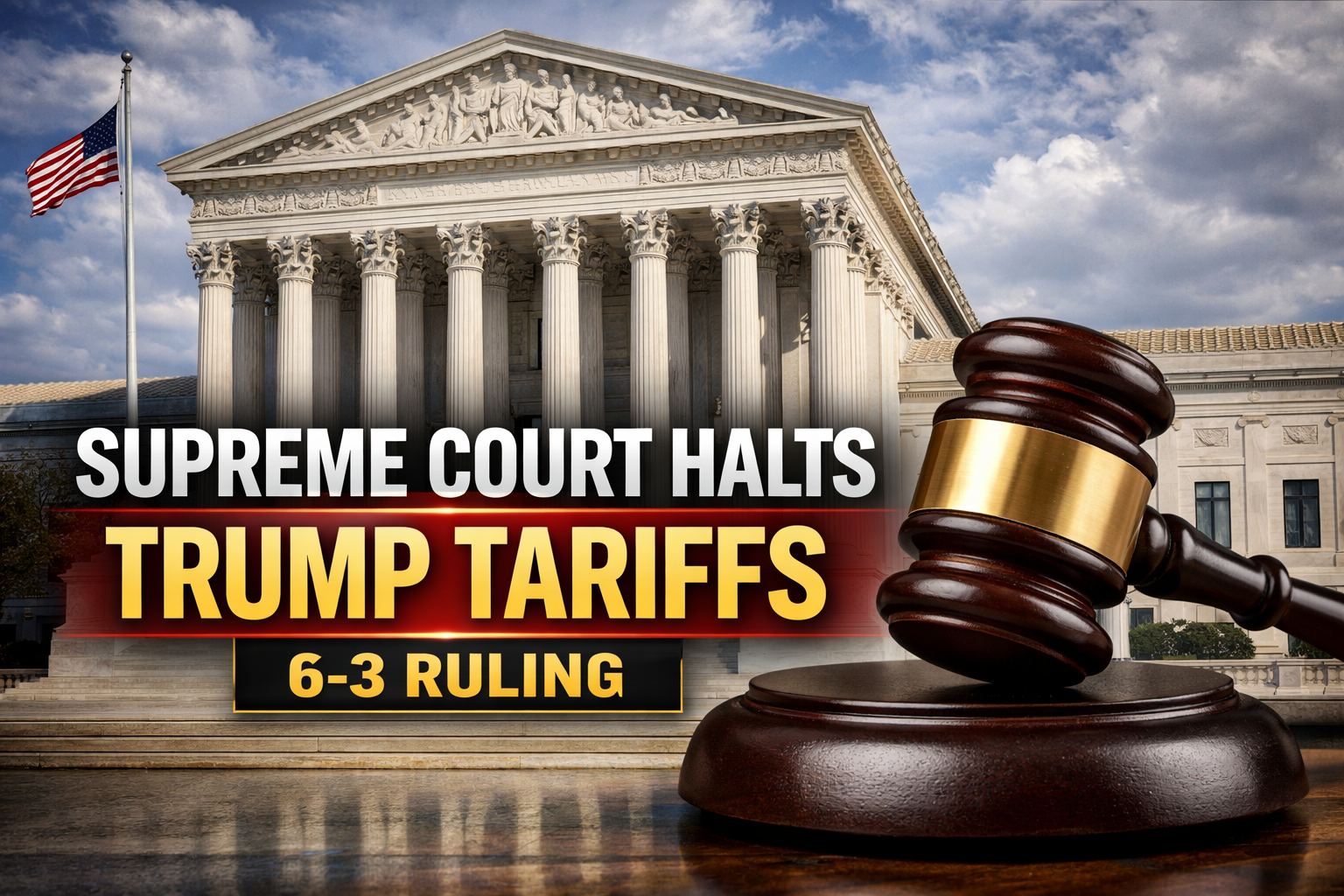
WASHINGTON, D.C., February 20, 2026 — In a seismic ruling this Friday, the U.S. Supreme Court struck down most of former President Donald Trump’s tariff regime, holding in a 6-3 decision that his use of the International Emergency Economic Powers Act (IEEPA) to impose sweeping import duties exceeded presidential authority. The decision marks one of the most significant legal rebukes of a major policy of the Trump administration’s second term.
Chief Justice John Roberts, writing for the majority, concluded that the narrow statutory language of IEEPA — which allows the president to “regulate … importation” during declared emergencies — does not encompass the expansive power to levy tariffs on foreign goods at the president’s discretion. “When Congress grants the power to impose tariffs, it does so clearly and with careful constraints,” Roberts wrote in the opinion. “It did neither in IEEPA.”
The high court’s opinion effectively invalidates broad tariff measures that had applied duties of up to 10% on most U.S. trading partners, as well as higher “reciprocal” levies targeting countries like China, Canada, Mexico, and members of the European Union under the Trump policy known as Liberation Day tariffs.
🧠 Constitutional Limits on Executive Power
The decision rested primarily on constitutional separation of powers principles and the so-called major questions doctrine — a legal standard that holds if Congress intends to delegate decisions of vast economic or political significance, it must do so explicitly. Roberts noted that IEEPA contains no reference to tariffs or duties, and that until now, no president had ever interpreted the statute to confer tariff authority.
In a portion of the majority opinion joined by Justices Neil Gorsuch and Amy Coney Barrett, Roberts emphasized that allowing a president to impose tariffs without clear congressional authorization would upend the constitutional allocation of taxing powers.
📉 Economic and Policy Uncertainty
The ruling immediately raises practical and legal questions about the fate of billions of dollars collected under the now-struck tariffs. Estimates vary, but some experts suggest that the government could face claims for refunds totaling well over $100 billion from businesses and importers who paid those duties.
Complicating matters further, the majority did not specify whether tariffs imposed under other statutory authorities — such as Section 301 of the Trade Act of 1974 or Section 232 of the Trade Expansion Act of 1962 — remain fully intact. Many analysts expect continued litigation and regulatory challenges as the federal government works to recalibrate its trade enforcement toolkit.
🧑⚖️ Dissenting Justices Weigh In
The three dissenting justices — Clarence Thomas, Samuel Alito, and Brett Kavanaugh — sharply disagreed, asserting that tariffs have historically been a tool for regulating foreign commerce and thus fall within the executive’s broader statutory authority when tied to national security emergencies. In Kavanaugh’s dissent, he warned that the majority’s narrow interpretation could hinder the nation’s capacity to respond swiftly to economic threats and could disrupt long-standing trade mechanisms.
🗣️ Administration And Political Reactions
Former President Trump reacted forcefully to the decision, describing it as “a disgrace” in comments made during a meeting with Republican governors shortly after the ruling was released. Trump argued that tariffs were essential to American economic security and criticized the judiciary for undermining executive power.
Republican leaders in Congress expressed frustration as well, but many acknowledged the need for legislative action to codify clearer tariff authority if future presidents are to wield such tools effectively. Some GOP lawmakers noted that the Constitution assigns taxing and tariff powers exclusively to Congress, underscoring the judiciary’s role in maintaining the separation of powers.
📣 Business And Trade Reactions
Business groups, particularly those representing manufacturers and import-dependent industries, welcomed the ruling, arguing that the tariff regime raised costs for American consumers and disrupted supply chains. Economists aligned with free-market principles similarly warned that sudden tariff changes could harm U.S. economic competitiveness and invite retaliatory measures from trade partners.
🌎 Global Ramifications
International reactions have been cautious. Foreign governments including Canada and European allies acknowledged the legal ruling’s implications for trade relations and stressed the importance of predictable, rule-based commerce. Some foreign officials expressed relief that the legal constraints on executive tariff authority could reduce the volatility seen in global markets over the past year.
📈 What Happens Next
Legal experts say the decision will prompt a cascade of follow-on litigation and legislative proposals. Some Republicans are expected to push a trade authority bill that would explicitly give the president more bounded tariff powers under narrowly defined circumstances. Others argue for stronger congressional oversight and a return to bipartisan trade policy frameworks established in past decades.
Regardless of the path chosen, the Supreme Court’s ruling has reshaped the landscape of U.S. trade policy and clarified the constitutional boundary between executive action and legislative authority. The debate over trade and tariff policy — from job creation to national security — is certain to remain a defining issue of the 2026 midterm election cycle and beyond.
Keywords
-
Trump tariffs
-
Supreme Court ruling
-
IEEPA
-
major questions doctrine
-
executive power limits
-
trade policy
-
import duties
-
tariff refund claims
-
constitutional separation of powers