

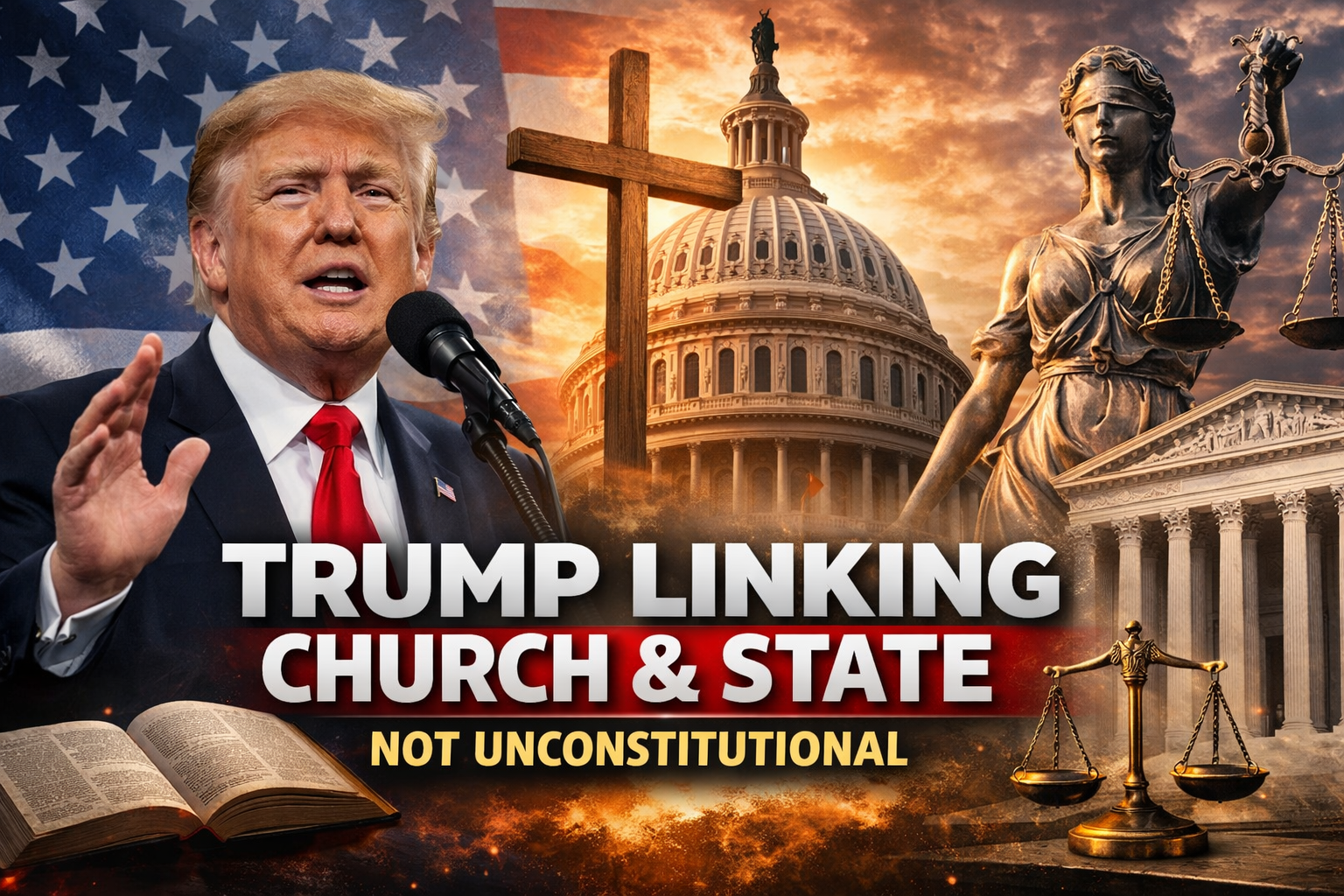
Trump Linking Church and State – NOT Unconstitutional
Recent commentary surrounding former President Donald Trump’s public embrace of faith in governance has reignited debate over the meaning of the First Amendment’s Establishment Clause. Critics claim Trump has “chipped away” at the long-standing wall between church and state. Supporters counter that such assertions misrepresent constitutional history and modern Supreme Court jurisprudence.
At the heart of the dispute lies the phrase “separation of church and state,” language that appears nowhere in the U.S. Constitution. The First Amendment states, “Congress shall make no law respecting an establishment of religion, or prohibiting the free exercise thereof.” Constitutional scholars note that this language restrains the federal government from establishing a national church while simultaneously protecting the free exercise of religion.
Trump’s recent public statements and policy positions emphasize religious liberty protections, including expanded space for faith-based organizations to participate in public life and federal programs. Supporters argue that such policies align with Supreme Court rulings that have increasingly affirmed the rights of religious institutions to operate without discrimination.


Legal observers point to recent Supreme Court decisions that have reshaped the constitutional framework governing religion in public life. In cases such as Supreme Court of the United States rulings involving public funding and religious institutions, the Court has rejected rigid “Lemon Test” standards in favor of historical analysis. This shift reflects a growing judicial preference for interpreting the Establishment Clause through the lens of the nation’s founding traditions.
Conservative legal analysts argue that Trump’s approach does not establish religion but restores parity for religious Americans in public spaces. They cite decisions affirming that religious schools may receive public benefits on equal footing with secular institutions and that expressions of faith by public officials do not automatically violate constitutional principles.
Critics have framed Trump’s rhetoric as an erosion of the “wall” between church and state. However, originalist scholars note that the “wall” metaphor originated in a private letter written by Thomas Jefferson to the Danbury Baptists, not in the Constitution itself. They contend that Jefferson’s language was intended to prevent federal interference with religion—not to expel religion from public life.
Supporters of Trump’s stance emphasize that the Founders frequently referenced Providence and opened congressional sessions with prayer. The First Congress authorized chaplains shortly after drafting the First Amendment, a historical fact frequently cited in modern court decisions examining the meaning of religious establishment.
Recent posts on X have amplified the discussion. Several constitutional attorneys and public commentators have shared excerpts of Supreme Court opinions highlighting the distinction between coercion and acknowledgment. Videos circulating online feature Trump asserting that protecting faith-based initiatives strengthens civil society rather than undermines constitutional order.
One widely viewed video clip from a recent faith-policy forum shows Trump stating that government hostility toward religion is itself inconsistent with the First Amendment’s protections. The clip generated significant engagement, with supporters praising the emphasis on religious freedom and critics expressing concern about symbolic entanglement.
Legal experts aligned with conservative jurisprudence argue that acknowledgment of faith traditions does not equal establishment. The Supreme Court has repeatedly held that ceremonial references to God—such as “In God We Trust”—fall within historical practice and do not violate constitutional boundaries.
Opponents warn that increased collaboration between government and religious institutions risks favoritism. Yet defenders note that constitutional violations hinge on coercion or legal establishment, not voluntary cooperation or speech. They argue that Trump’s actions remain within established precedent, especially in light of the Court’s modern interpretive framework.


The broader constitutional question centers on whether expressions of faith by public officials amount to government establishment. Conservative constitutional scholars assert that neutrality does not mean secularism imposed by law. Instead, neutrality requires equal treatment of religious and nonreligious viewpoints.
Those close to Trump maintain that his policies reflect a belief that faith communities play a vital role in American civic life. They argue that excluding religious voices from public programs would contradict the Free Exercise Clause and modern Supreme Court rulings protecting religious institutions from discriminatory exclusion.
As debate continues, legal precedent appears to favor a historical-tradition analysis over strict separationist interpretations. Recent Supreme Court opinions suggest that public acknowledgment of religion, absent coercion or mandated participation, does not violate constitutional safeguards.
The controversy surrounding Trump’s posture toward church and state illustrates an enduring national conversation. For supporters, his stance reaffirms foundational liberties and rejects interpretations that marginalize religious expression. For critics, vigilance remains necessary to ensure constitutional guardrails are maintained.
The constitutional debate is unlikely to subside. Yet current jurisprudence indicates that acknowledgment of faith in the public square—when grounded in historical practice and devoid of coercion—falls within the bounds of the First Amendment.