

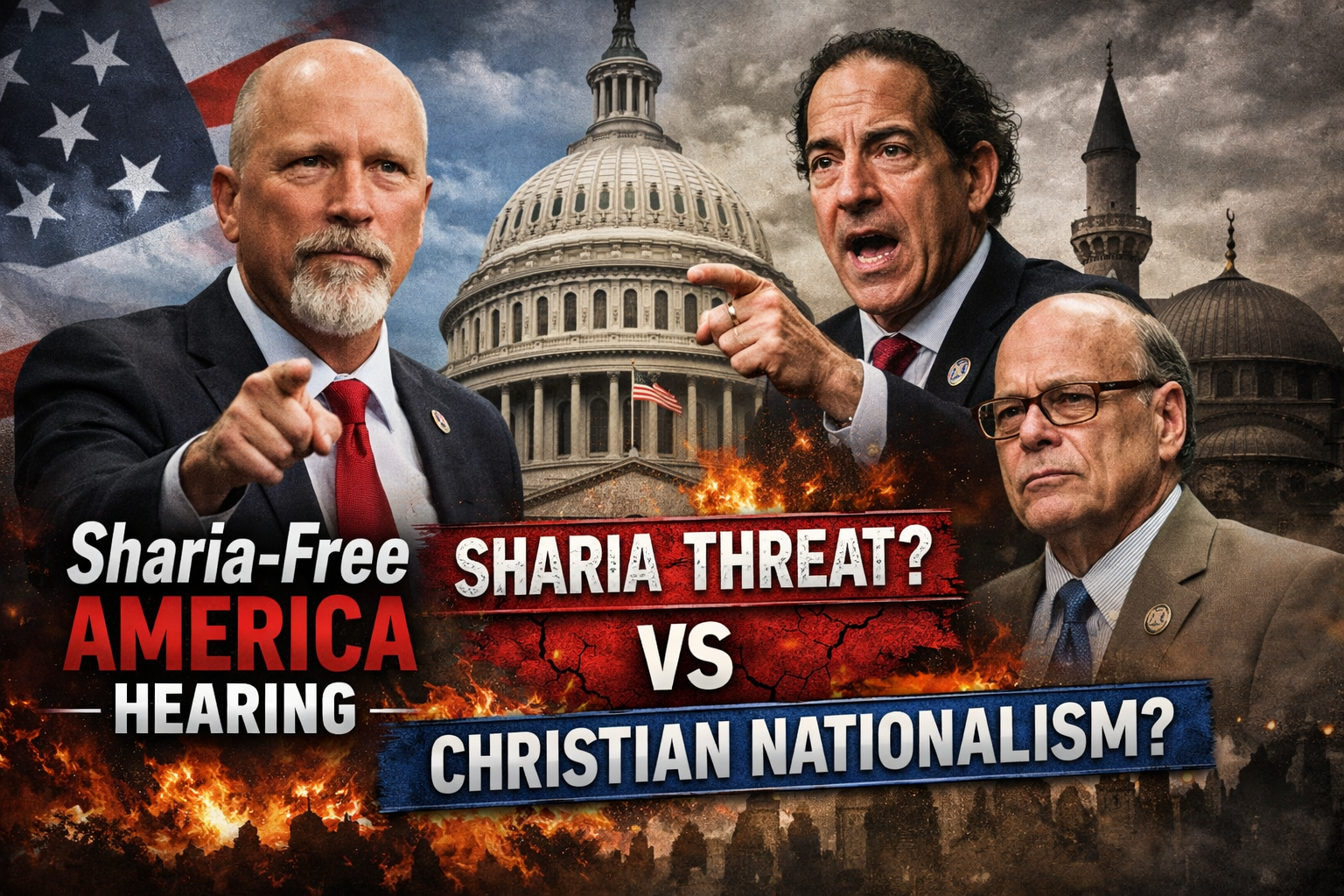
Sharia Debate Erupts on Capitol Hill as Democrats Dismiss Hearing, Warn of “Christian Nationalism”
WASHINGTON, D.C. — A sharply divided congressional hearing this week plunged longstanding tensions over religious law, national identity, and constitutional fidelity into the spotlight, with Republican lawmakers warning of the threat posed by Islamic Sharia law and Democratic members rebuking the forum as misplaced political theater.
On Tuesday afternoon, the House Judiciary Subcommittee on the Constitution and Limited Government held a two-hour session titled “Sharia-Free America: Why Political Islam & Sharia Law Are Incompatible with the U.S. Constitution.” The format drew starkly different reactions along partisan lines.
📺 Full Hearing Video:
Republicans Raise Constitutional Alarm
The hearing was chaired by Rep. Chip Roy (R-Texas), who has long sounded the alarm on Sharia law’s alleged encroachment on American governance and civil society. Roy’s remarks opened with concerns that Western legal norms and constitutional safeguards could be undermined by parallel legal systems rooted in political Islam.
Roy cited demographic shifts, immigration trends, and controversial developments like the proposed EPIC City — a planned 400-acre residential community near Dallas with a predominantly Muslim identity — as evidence that American legal norms were at risk.
He warned that if Texas became “ground zero” for what he described as Sharia influence, the whole nation could follow.
Expert Testimony: Sharia Law vs. U.S. Law
Several witnesses presented to the committee argued Sharia law is fundamentally incompatible with American constitutional principles — particularly the Supremacy Clause and Equal Protection standards.
Among them was Robert B. Spencer, a Shillman Fellow at the David Horowitz Freedom Center, who testified that Sharia represents a legal and moral system that often diverges sharply from the U.S. Constitution.
“Sharia law-based institutions are contrary to America’s founding principles,” Spencer said, asserting that Sharia’s legal and civic framework could conflict with federal law if allowed unchecked influence.
Another witness, Professor Ilya Somin of George Mason University, provided legal perspectives on constitutional incompatibilities.
Committee Republicans emphasized that courts in the United States already prohibit consideration of foreign or religious law when adjudicating civil matters — a stance reflected in state bans on Sharia in judicial settings.
Democratic Rebuttal: Distraction, Not Threat
Democratic members used their allotted time to push back, not primarily on the facts presented, but on the very premise of the hearing.
Ranking member Rep. Jamie Raskin (D-Md.) said concerns over Sharia were legally irrelevant given the Establishment Clause and Free Exercise Clause of the First Amendment, which together prohibit the government from favoring or establishing religious law. He argued that the hearing diverted attention from other national priorities.
“We live in a country so great we don’t need anti-Sharia legislation,” Raskin said, asserting that worries about Islamic legal influence are unfounded.
Another Democrat, Rep. Steve Cohen (D-Tenn.), stirred laughter by comparing warnings about Sharia to criticisms frequently levied against conservative policy blueprints such as Project 2025.
Several Democrats seized the moment to pivot discussions toward concerns about white Christian nationalism, contending this was a more pressing threat to American democracy than Islamic legal influence.
Their comments underscored a larger partisan divide over the framing of religious identity, constitutional order, and national security.
Republican Pushback on Partisan Reframing
Committee Republicans hit back sharply at the Democratic framing.
Rep. Glenn Grothman (R-Wis.) accosted the notion that “white Christian nationalism” posed a greater danger than foreign legal structures. He said he had never met anyone claiming affiliation with the term “Christian nationalist,” suggesting the label exists largely as a political wedge rather than a real ideological movement.
Rep. Brandon Gill (R-Texas) cited a recent survey indicating that significant shares of American Muslims support elements of Sharia’s legal application and restrictions on religious depiction — data he argued justified legislative scrutiny.
Public Reaction on X
Here are real reactions from X/Twitter that reflect the strong public interest in the hearing:
Christian Post (@ChristianPost):
Democrats dismiss House hearing on Sharia threat, warn of ‘white Christian nationalism’ — 359 views.
Rep. Chip Roy Press Office (@RepChipRoy):
Would it be safe to say that the goal of those organizations and the Muslim Brotherhood is for Western civilization… to become Islamic? — Feb. 10, 2026.
Wider Context
The Sharia hearing did not emerge in isolation. In Texas, Lt. Gov. Dan Patrick announced state hearings on CAIR and Sharia concerns, following a controversial proposal for a large Muslim community development and heightened scrutiny of Islamic centers.
Across the country, debates over religious law and constitutional integrity have periodically surfaced in public policy — from historic Oklahoma ballot measures aimed at preemptively banning Sharia in courts to ongoing disputes over immigration and national identity.
Impact and Implications
Although Democrats dismissed the hearing’s premise as misplaced, Republicans underscored what they consider existential stakes: preserving the U.S. Constitution against any parallel legal systems or civic structures that could erode constitutional protections.
The hearing laid bare deep philosophical differences about how religious identity intersects with law, whether federal safeguards are sufficient, and how national security is perceived through differing ideological lenses.
With continued discussion at both the federal and state levels, the debate over Sharia law’s place in American public life is likely to persist as a flashpoint in broader cultural and constitutional conflicts.