

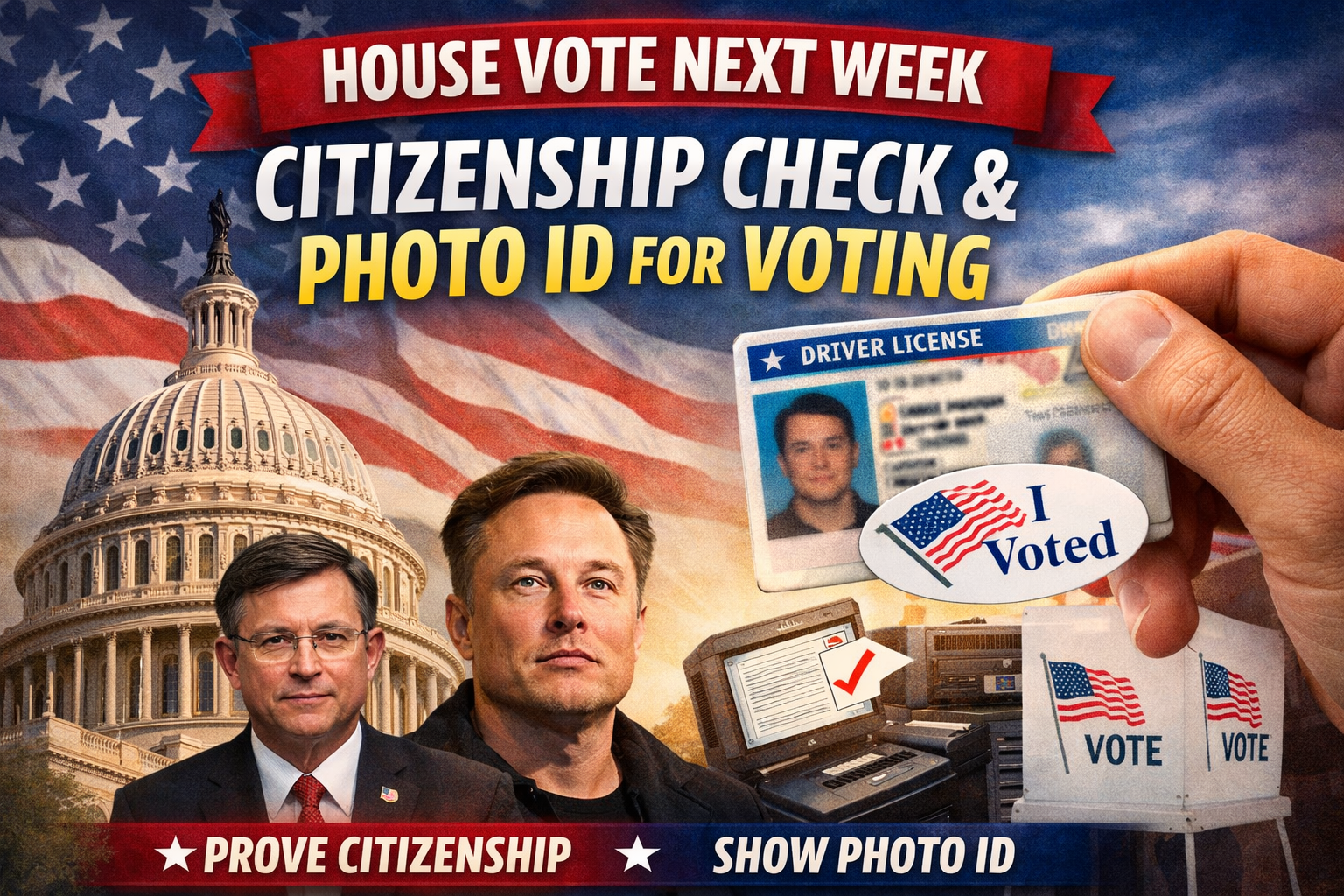
House Set to Vote Next Week on Citizenship Checks and Photo ID Requirements for Voting
WASHINGTON — The U.S. House of Representatives is poised next week to take up a significant election-integrity measure that would require Americans to provide proof of U.S. citizenship when registering to vote and to present valid photo identification at the polls. The move comes amid growing Republican pressure on the Senate to act and repeated endorsements from Republican leaders and civic voices who call the reforms “common-sense protections” for the republic’s electoral process.
The centerpiece of the legislation is the Safeguard American Voter Eligibility Act (SAVE Act), a bill first passed by the House in 2025 that would amend the National Voter Registration Act to mandate “documentary proof of United States citizenship” for voter registration.
Under the renewed push, Republicans are also pushing to add or emphasize a PHOTO ID requirement that voters show a government-issued photo identification before casting a ballot. GOP leaders argue that requiring photo ID — already in place in dozens of states — is a logical extension of verifying legal voter eligibility and strengthens public confidence in elections.
House Speaker Mike Johnson (R-La.) and other GOP leaders have framed the upcoming vote as a defining moment for election security ahead of the November 2026 midterms. The measures are tied closely to broader efforts by Republican lawmakers to shore up election integrity and eliminate any potential for non-citizen registration or voting that they argue could undermine public trust.
Broad Public Support for ID and Citizenship Verification
Polling on voter ID laws consistently shows significant public support across party lines. Recent data indicate that a strong majority of Americans, including independents and members of both major political parties, back requirements that voters provide valid identification before voting.
Advocates argue that photo ID is not an onerous requirement; instead, they say, it aligns voting with other everyday activities such as boarding an airplane, entering secure facilities, or conducting financial transactions, all of which require valid identification. They also argue that citizenship verification at registration addresses the clear constitutional requirement that only U.S. citizens may vote in federal elections.
Elon Musk and Activist Voices Amplify Conservative Push
Adding a high-profile voice to the debate, Tesla CEO Elon Musk recently took to X to urge Congressional action. Musk asserted that tightening proof-of-citizenship requirements is essential “or democracy is dead,” echoing conservative commentators’ calls for robust safeguards in the electoral process.
Example X post (embedded):
@elonmusk: “The two critical factors for voting integrity and saving democracy in America are simply requiring ID + proof of citizenship.”
Senate Prospects and Procedural Challenges
While the House appears ready to pass the expanded SAVE Act and photo ID provisions, Republicans face a more uncertain road in the narrowly divided Senate. Senate Majority Leader John Thune (R-S.D.) has indicated that a vote “will happen at some point,” but has stopped short of promising a specific timeline, reflecting the procedural hurdles inherent in Senate rules and potential filibuster barriers.
Senate Democrats have strongly opposed the proposals, characterizing them as voter suppression efforts that could remove eligible citizens from rolls or create unnecessary barriers. Senate Minority Leader Chuck Schumer (D-N.Y.) has used inflammatory language to frame the debate, describing the bill as akin to “Jim Crow 2.0.”
Legal Context and Ongoing Debate
Legal challenges continue to shape the backdrop for federal election legislation. Last week, a federal judge struck down expanded citizenship provisions within a Trump executive order that sought to require citizenship verification by federal agencies distributing voter registration forms, reaffirming constitutional limits on unilateral executive action over elections.
Republicans point out that federal law already prohibits non-citizens from voting in federal elections. They argue adding documentary proof and photo ID requirements will simply bolster enforcement and close potential loopholes where foreign nationals might inadvertently end up on voter rolls due to administrative inaccuracies.
Political and Cultural Stakes
The timing of the House vote aligns with a broader Republican strategy to emphasize election integrity as a central campaign issue for the 2026 midterms. GOP lawmakers contend that stronger verification requirements will not only safeguard elections, but also enhance voter confidence by ensuring that only citizens eligible under the Constitution participate.
Critics, however, remain steadfast in their opposition, arguing that additional documentation requirements could inadvertently disenfranchise legitimate voters, particularly those in rural communities or those who face difficulties obtaining certain forms of documentation.
Despite these debates, the House move represents one of the most significant federal efforts in recent years to set uniform election standards that include citizenship checks and photo identification requirements.
High-Value Keywords
-
SAVE Act
-
voter ID requirement
-
citizenship verification
-
election integrity
-
House vote
-
voter fraud prevention
-
Republican election bill
-
Senate prospects
-
Elon Musk voting reform